Widows All the Way Down
After an messily ambitious trip to New York City, Castration Movie returns to Vancouver with a tight and excruciating depiction of a relationship broken by transition.


WARNING! ATROCIOUS SPOILERS FOLLOW
I was waiting until Louise Weard had released the complete third part of Castration Movie to discuss this first "fragmentary passage" of it, which she's detached and has been touring theaters with. I wasn't sure it was capable of standing entirely alone, but after a second watch I'm convinced it does, so here we are. Entitled Junior Ghosts—Premorphic Drift, the chapter returns us to Vancouver, B.C., where the first two chapters of Castration Movie took place, and fills us in on the lives of some the principle characters.
To anyone who was betting on Turner—the charismatically loathsome incel-in-training whose story opens the whole saga—ending up being a trans woman: I regret to inform you you were dead wrong. We quickly learn (quickly at least by Weardian standards) that he has committed a mass murder, charging one morning into a support group for women who've lost their children and stabbing a bunch of them. Junior Ghosts opens with the scene immediately after the spree: sobbing, blood, a camera wandering trepidatiously around the space. It's very much not funny—any lingering sympathy one might have had for Turner, even just in the spirit of the devil's advocate, is now beyond the pale.

It's interesting that Weard chose a mass stabbing rather than a mass shooting. Mass shootings are certainly less common in Canada than down here, but they do happen, so it's not unthinkable, which leads me to suspect this is an intentional choice. On the one hand, realistically depicting the aftermath of a mass shooting would be much more difficult for a filmmaker with a minimal budget, and also might strain the boundaries of good taste (even Castration Movie must have some boundaries); on the other, the greater intimacy of the act of stabbing makes it even more heinous. Besides, considering himself so great and unprecedented a soul, Turner might very well believe that doing a mass shooting like everyone else would be an insufficiently distinctive way to make his impact.
In this and other ways, while he never makes an appearance in Junior Ghosts, Turner looms very large over the proceedings—a specter of gratuitous, narcissistic white male violence under whose maniacal watch, it seems, the rest of us are only permitted to exist.
We're not entirely sure about what has happened at the outset, but we find out as our main plot settles in, watching Turner's (former) hometown friend Izzy (Avalon Fast)—who we last saw in Polygon!!!! Heartmoder (a.k.a part two) in New York City, affirming Ivy Wolk's Keller on the silliness and futility of transition—taking a call for her work-at-home job as a crisis line counselor. This particular call turns out to be extremely awkward, because the caller is a survivor of Turner's massacre. In the midst of an understandably self-centered grieving process for something unimaginably horrific, the caller's tone alternates, for my ears, between sympathetic and irritating, delivered with voice so grating over the phone that I could only assume the actor was trying to overdo it a bit.
Izzy is a patient listener, but she seems impatient and frustrated as the caller begins to rage against Turner and "everyone who helped him become what he was." Izzy seems to feel blamed by this comment, even though there isn't any reason to be, and by the end of the call she's all but revealed that she used to be friends with the guy. While she never completely takes control of the conversation, she threatens to several times—our first intuitions of the blind spots of her ego, which simultaneously keeps everyone at a distance but can't bear to feel left out.
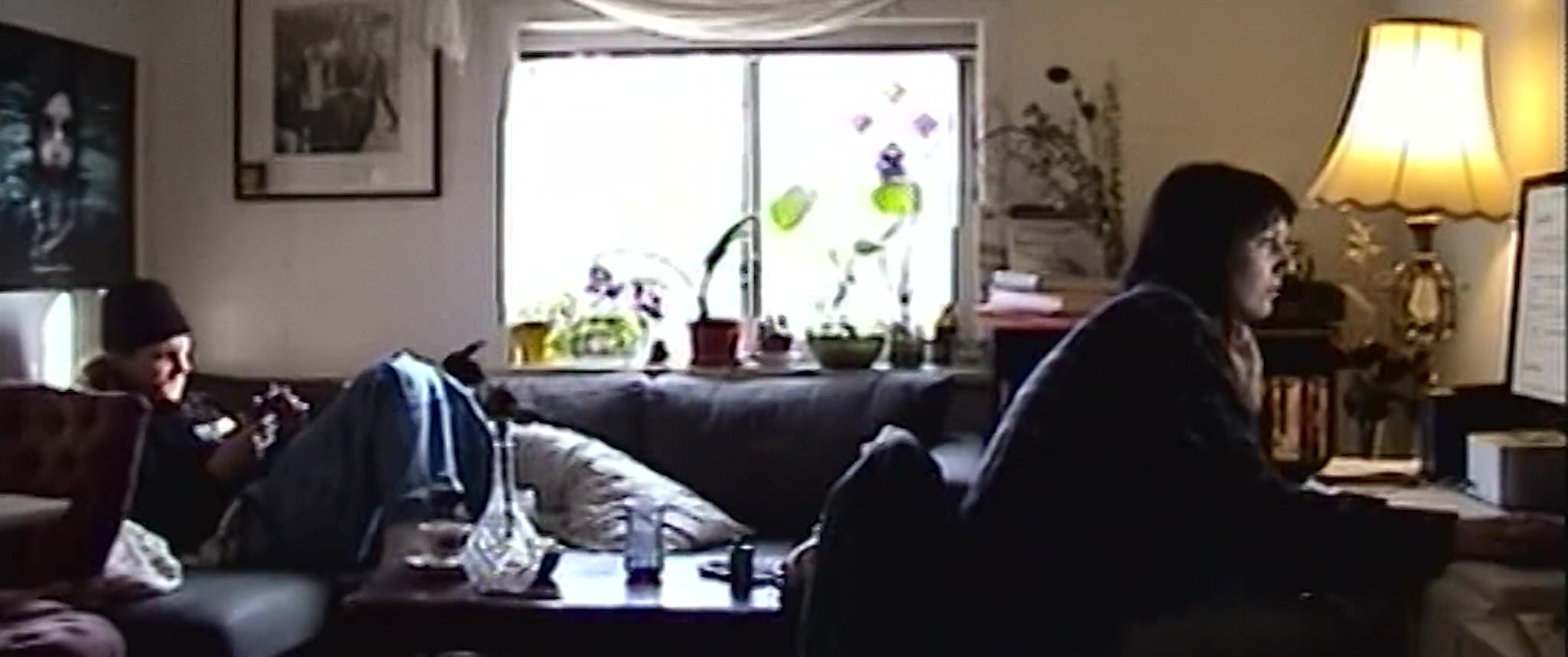
Her boyfriend Trent (Henri Gillespi) enters the scene, and it's clear from the way she bosses him around that Izzy wears the pants in the relationship (and also in bed, where it's revealed that he likes being ridden and called a "little bitch"). As in many relationships, her bossiness enables his defensive incompetence—he's effectively an emotional support animal for her to emotionally abuse. To be fair, though, Trent does seem like a total deadbeat: he's been unemployed for a long time and doesn't seem to do much aside from go skating and daydream—and Izzy is about to find out that he's been daydreaming about being trans. The fantastic scene in which this occurs has been circulating online for some time:
Weard is at her best depicting these kinds of tense moments between friends and lovers—in many respects, Castration Movie is just a series of conversations and arguments landing somewhere between hilarious and unbearably painful, with breaks to diffuse the tension.
Trent, to be hereafter referred to by her chosen name, Tiffany, is a classically cringe baby tran, right down to that tarty name choice, which has the ring of a sorority girl, if not a porn star. While she's no alpha male, she's not conspicuously feminine either—she appears to be just a muttering, wears-a-beanie-year-round alt boy, and we will see later that she had apparently paid little attention to women's lives so far—she isn't even aware what sort of makeup Izzy uses. Given that, like most cis people, Izzy has no awareness of the common psychodynamics of transfemininity, she has every reason to be baffled and think there were "no signs" and that this whole thing just came out of nowhere, a product rather than a source of Tiffany's inertia-driven boredom. Tiffany, however, doesn't know how to explain herself except vaguely—"I dunno... It's not always like that... I wasn't raised around an environment where [transness] would seem to be acceptable"—and one can imagine she's been spending time online in trans spaces where it's taken for granted that one shouldn't really have to explain one's self, and that transition is an inherently positive development that should be celebrated, full stop. We don't see this in the film, but we do see a cute interaction with a charmingly lackadaisical nonbinary AFAB friend at the skatepark who simply advises Tiffany to go with it.
My read on the tension here is that Izzy is less angry about the prospect of Tiffany's transition than the fact that Tiffany is suddenly and bluntly (and in many respects, literally) asserting herself. It's apparently ludicrous that her partner might be able to think for herself or have any ideas about herself that Izzy wasn't already aware of: "Sorry," she says, condescendingly, "you just don't seem like... like our relationship—there's no dynamic... I just feel like you've gotten into some, like, thing. I just don't think you've thought this through enough." Tiffany admirably pushes back—"So you think you can decide this for me?"—but Izzy is a far more formidable emotional arguer.
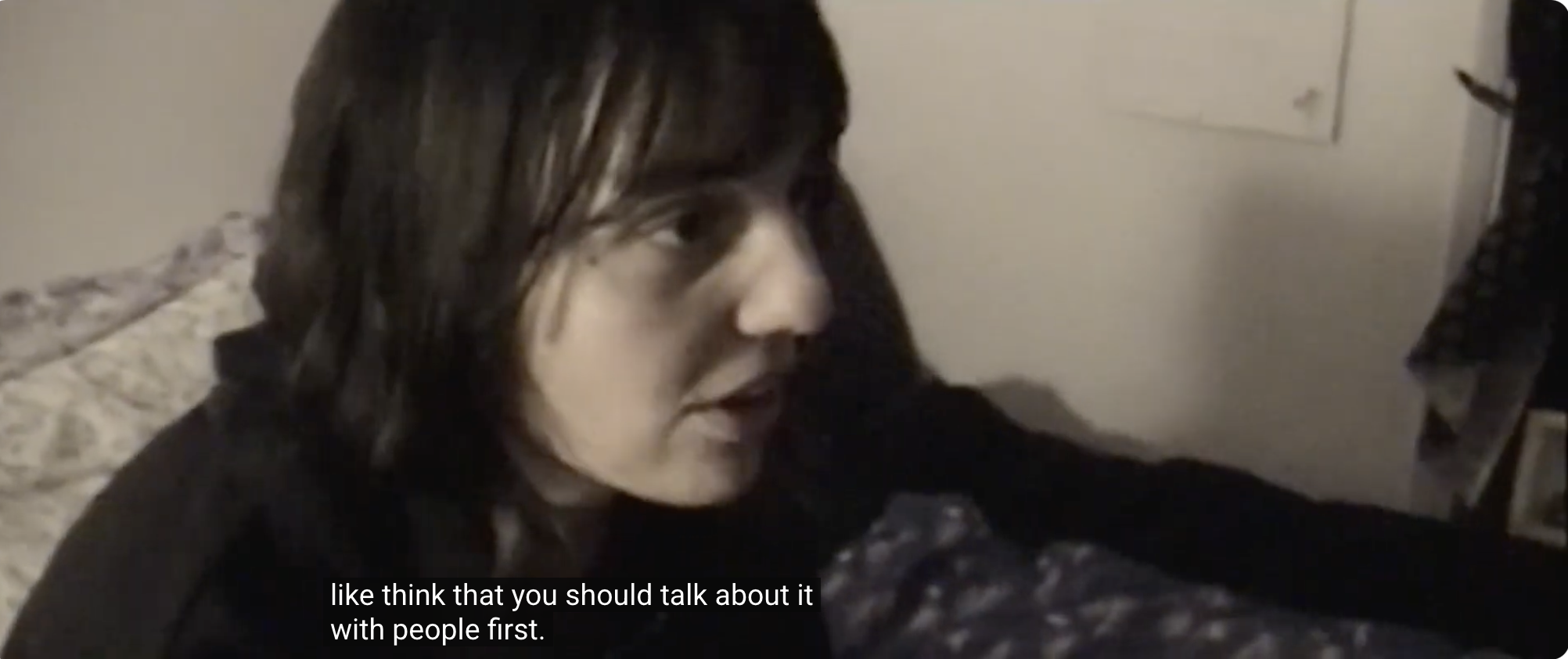
Avalon Fast's fatuously incredulous performance shows a deep understanding of the skill with which many women avoid recognizing their own arrogance, aggression, or controlling thoughts and behaviors, eternally seeing themselves, especially with people they regard as male, as the put-upon person in the equation, the sweetheart who could never do wrong. Michaela, the star of the greater two-thirds of Castration Movie's first part, is a trans example of this phenomenon, so it's hardly a surprise to find the two of them hitting it off later, when Izzy brings Tiffany to a support group for trans women that Michaela is improbably facilitating.
Before I get to Michaela's hilarious section, though, I want to speak in defense of the Izzys of the world. For some in early transition, every touch of femininity one permits one's self to reveal or adorn one's self with seems much weightier and more persuasive on the inside than it often does on the outside. It's dangerously easy to lose perspective. Setting out for their anniversary dinner—the couple have been together for many years, adding to the tension—Tiffany is determined to immediately go femme, hastily shaving her beard, slapping on some mascara and lipstick, and asking Izzy to choose between a couple of equally unflattering dresses Tiffany purchased at a thrift shop or something. Fiction, whether literary or cinematic, has a wonderful power to show us multiple perspectives at the same time, and I feel both happy for Tiffany in this moment and embarrassed for her as she makes what, to Izzy, feels like a clumsy, half-assed, hopelessly male attempt at womanhood.

Even the faggiest among us still have a lot to learn—think of Dylan Mulvaney's notoriously cringe transition vlog (love you queen, no shade). There isn't some fully formed adult woman inside every "egg," waiting to be let out. That woman, like all women, has to be developed, and that means speedrunning, in the span of a few years, everything cis women spend their whole childhoods and early adulthoods learning. There is perhaps a maximally dignified way to go about this process, but the chances of entirely avoiding being cringe or off-putting are about as high as the chances of getting through one's original adolescence without embarrassment—those aren't betting odds, friend.
As the cis partner of an early transitioner, you can either see past this or you can't, but it's all the more difficult to see past it if your partner, like Tiffany, is acting as if everything you're seeing should be normal and fine and cause for celebration, or else one-sidedly looking to you for patient, empathic support throughout a daunting spiritual, psychological, behavioral, and physical process that you can't begin to really fathom. It's never totally clear whether Izzy is even open to being with a woman, trans or not, but she finds herself in the unenviable position of being with someone who is neither. One of her most forgivable moments comes when they try to have sex after their anniversary dinner, and Izzy just can't take it seriously. Why should she be able to be? Tiffany continues to insist that she hasn't changed, she's still the same person, but for Izzy, she isn't, and Tiffany doesn't seem to recognize or care, and when she's confronted with this, she bats it away indignantly.
Over the course of Junior Ghosts, Tiffany's transition pushes both partners deeper into the pathologies that compromise their relationship—Izzy into her cynicism and arrogance, Tiffany into her willful naiveté. "I feel euphoric!" Tiffany insists at the end of one argument. Yeah babe, I want to say, I bet you do. Surely it takes courage to do what she's doing, but a lot of newly out trans women are so high on rediscovered self-love that the dominant note is more foolhardiness than courage.
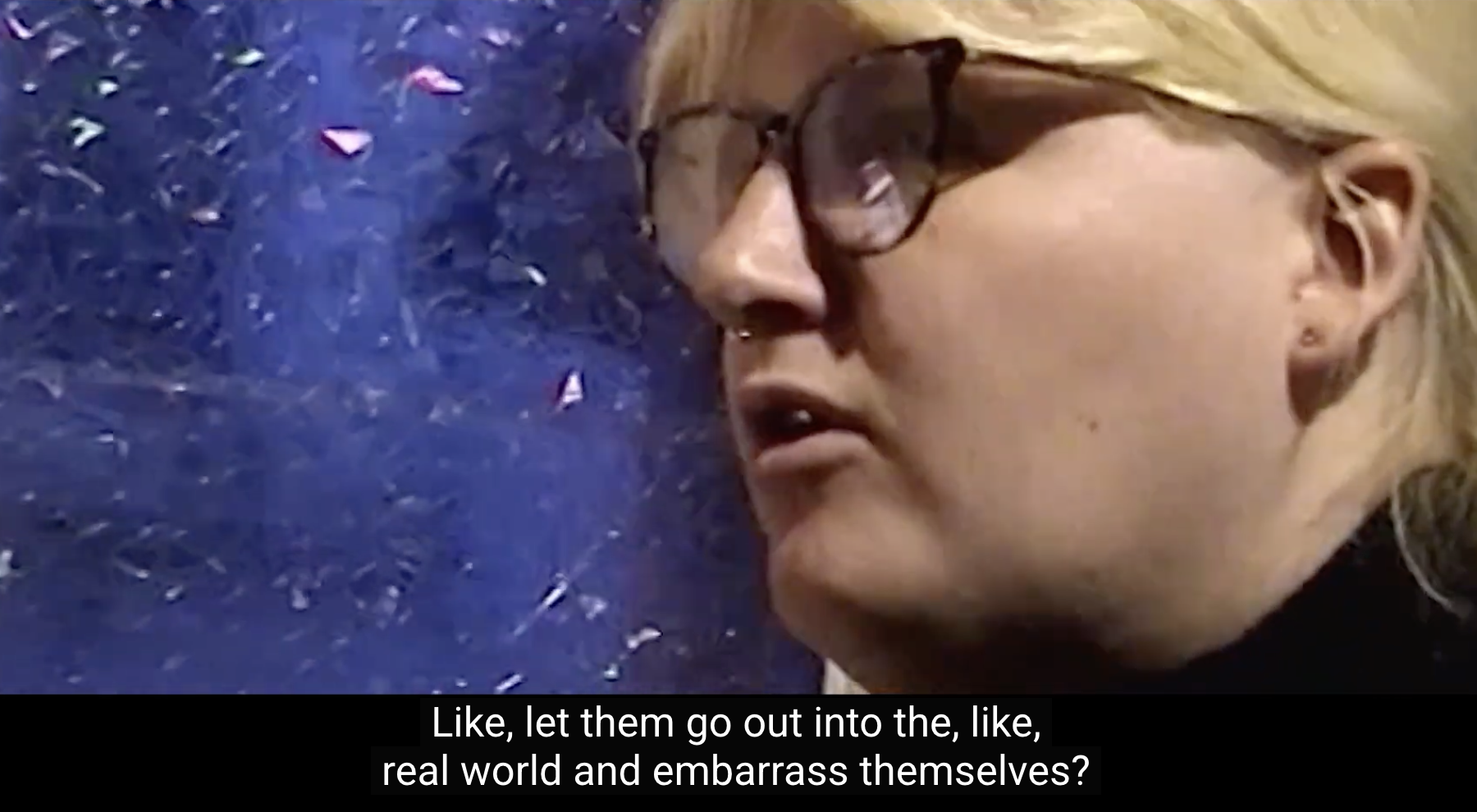
There is another perspective, of course—a far more pessimistic counterpoint shared, in different ways, by both the snobby dolls of the world and the wretched boymoders haunting some of the darkest corners of the Internet. These are the girls who say transition is virtually impossible: most who try are doomed to fail, but hardly anyone ever really tries, because most of us prefer the comforts of closeted, sexed-up fantasy to the banalities of actual, day-to-day womanhood. The embodiment of this sort of naysayer in Castration Movie is of course Michaela "Traps" Sinclair, the haplessly inappropriate trainwreck who spreads her chaos across much of the film's first part. Weard, who plays Michaela herself (the whole meaning of the film, perhaps, hinges on understanding why this must be so), makes a point during talkbacks and interviews of saying that if you can relate to Michaela, you seriously need to check in with yourself. Michaela thinks what you're not supposed to and says what you're not supposed to and she continually frames it as helpful advice rather that the compulsive and pitiless cruelty of a deeply insecure person.
As I mentioned earlier, she has somehow wound up running a support group for other trans women, and we see her getting grilled by the folks managing the organization it's a part of, one of whom, a they/them AFAB named Kane, is played by Jane Schoenbrun. Their attempts to wokely scold Michaela for the incredibly rude (and also incredibly hypocritical) things she says to her group members regarding their dress and comportment perfectly mirrors Schoenbrun's own severity and discretion as a filmmaker, such that the clownish HR-style interaction becomes a meta-commentary on the pair's vastly different cinematic approaches—Schoenburn would amusingly return the favor in Teenage Sex and Death at Camp Miasma by casting Weard as a pickme Hollywood trans woman whose only apparent purpose is to rubber-stamp the inanities of her cis colleagues, as if to suggest that it's actually Castration Movie's nigh-relativistic irreverence toward transfeminine life, rather than Schoenbrun's cautious coding of trans experience in cis-friendly analogies, that constitutes the real sellout gesture.
And that may well be the case. Even I, one of the biggest Castration Movie fans in the Universe, have to wonder if all this dirty laundry Weard is airing can only appear as a freak show to the curious cis cinephile who's simply looking for some radical shit to brag about watching. For now, the film feels like a perversely loving gift to a certain kind of trans woman, but its legacy may be stranger—how long until actual incels discover Noah Baker's incredible performance as Turner and crown him as one of their idols—another Patrick Bateman, Tyler Durden, or Todd Phillips Joker? How long until TERFs find a new icon in Izzy?
Distant possibilities, perhaps, but this is bold material to produce at a time when trans rights are eroding and trans people are among the most conspicuous scapegoats in popular political discourse. We may never have wanted to be placed on a liberal pedestal, but Castration Movie, while certainly not reactionary, does lend itself in many moments to a reading of trans life as hopelessly alienated and possibly doomed, and it rarely takes interest in naming our socio-political enemies directly or gesturing toward productive ways to fight back. As I've argued before, the film's whole political power is to show us the fullness and hideousness of trans women's humanity, rather than veil or sugarcoat it. But is that actually a good idea right now? Or, despite its abundance of compassion, is the film ultimately too in thrall to the puerile allure of sicko shit, to the satisfaction of cracking in-jokes on the big screen? Weard, I think, trusts that a devotion to absolute cinema—that is, to absolute truth—is its own justification, but something strange about the truth is that it tends to be a little inconvenient to everyone, and absolute truth is absolutely inconvenient. Great art will be problematic in one way or another—not, again, in the cheapened sense of that term as merely reactionary, but in the original sense of presenting us with genuine problems that demand we revise our frameworks—or else simply sharpen our swords.

I've heard that some trans viewers got very angry at Izzy when they watched Junior Ghosts, to the point that they actually got mad at Avalon Fast (very uncool), but I feel completely the opposite. I love Izzy—not what she does, but her passion, the way she forces Tiffany to prove herself beyond her capacity. She is a stronger person, and Tiffany can't do anything about that. There is a hurt little girl implied somewhere in Fast's performance who was sold an absolute bill of goods, and even if Izzy isn't right, that little girl is.
At the end of the film, Izzy, now abandoned, takes another hotline call, this time from a young and desperate closeted rural trans girl who is unable to transition. The girl is a sweetheart and, for what it's worth, far more feminine-seeming than Tiffany, but Izzy is resolute, exhibiting a perverse ethical integrity as she tells her client that if she can't make it as a boy, then maybe she really should kill herself. End of chapter. Woof.
Avalon Fast is ice cold in this scene, delivering her verdict with neither relish nor bile, and there is something heroic in her total determination—it's a terribly misguided heroism, but it's a stunning commitment to the bit. This whole chapter is like a dark version of one of those Mister Rogers tours of a factory, showing us how the raw materials of personal frustrations, cultural biases, and failed empathy become a wish for total repression, if not extermination, of a population.
Transition, I believe, should partly be a coming-clean—not that you have to go through the whole Twelve Steps, just that you should recognize the consequences of your deceptions. Some people will miss the Old You and feel betrayed, and they're not entirely wrong for that, and it's a bit ridiculous to assume you can change something so fundamental about yourself without altering the world and people around you. Izzy's TERFdom is certainly not Tiffany's fault, but Junior Ghosts forces us trans folks to admit that we do harm others with the lies we tell about ourselves prior to transition, and we're not off the hook just because we also believe those lies—that just means they were good ones. Trans people prefer to emphasize the great extent to which their deceptions were coerced by a violently normative society, and they were, but we still made the choice, however compromised, to comply—and then, suddenly, we didn't. Here I'm reminded of that one Mark Fisher quote from Capitalist Realism:
To reclaim a real political agency means first of all accepting our insertion at the level of desire in the remorseless meat-grinder of Capital. What is being disavowed in the abjection of evil and ignorance onto fantasmatic Others is our own complicity in planetary networks of oppression. What needs to be kept in mind is both that capitalism is a hyper-abstract impersonal structure and that it would be nothing without our co-operation. The most Gothic description of Capital is also the most accurate. Capital is an abstract parasite, an insatiable vampire and zombie-maker; but the living flesh it converts into dead labor is ours, and the zombies it makes are us. There is a sense in which it simply is the case that the political elite are our servants; the miserable service they provide from us is to launder our libidos, to obligingly re-present for us our disavowed desires as if they had nothing to do with us.
Coming to terms with our dependence on the complicity of which Fisher speaks is painful, and in that sense, transition is something to be survived, both for the transitioner and their loved ones—and not everyone on either side makes it. Despite insistence that trans healthcare is "life saving" (and it very often is), a handful of us still end up killing ourselves anyway; some people we love just stop talking to us, and never stop stopping. Sometimes we just can't make it okay, and we have to seek peace elsewhere. The truth is inconvenient to everyone.