A Bushwick Version of The Divine Comedy
For the third chapter of Castration Movie, Louise Weard relocates to New York and doubles down on her painfully necessary satire of 21st century transfeminine life.


A few months into my transition, a trans friend of mine gave me the best piece of advice I’ve ever gotten about transition. When we hung out I often spoke to her about my impressions of online trans culture and the different subgroups into which we often sort ourselves. After a few circles back to this subject, she said something like “Don’t just look to trans women as models—look to all women.” I understood then that, out of shame for having been a man, I had been distancing myself from cisfemininity as if it were no concern of mine, but there was no need for this: I was I just a woman who came into womanhood by a different path—not from girlhood, but from manhood.
Accepting this allows you to get to the more interesting question: What does it mean for womanhood to blossom in these conditions? The first two chapters of Castration Movie explore (among many other things) the distinctions between beta males like the redpill victim Turner, whose story comprises the first chapter, “Incel Superman”, and, in the second chapter, “Traps Swan Princess,” the trans women who start out as beta males. We see in a stark light the frustrations of early transition and the marginalized status of trans women in a society that mostly sees us as perverts and/or fetish objects. Early transitioner Adeline (Aoife Josie Clements) all but buckles under the pressure of pursuing womanhood under such circumstances, while her codependent friend Michaela (Weard) adopts a “tough broad” attitude, accepting her place and trying to make the best of it, even as doing so erodes her soul. By the second chapter’s end, both characters are desperate and miserable.
In chapter three, “Polygon!!!! Heartmoder”, Weard unspools this thread of trans community further. Should you stick to the company of other trans women, who understand your plight, or will you all just drive each other crazy in your mutual alienation? Should you try instead to find a place in the cis world and among cis women, who will never fully understand you, or will that just make you hate yourself? Do other trans women even really understand you better? Is this whole transition thing even really working? Can it ever really work?
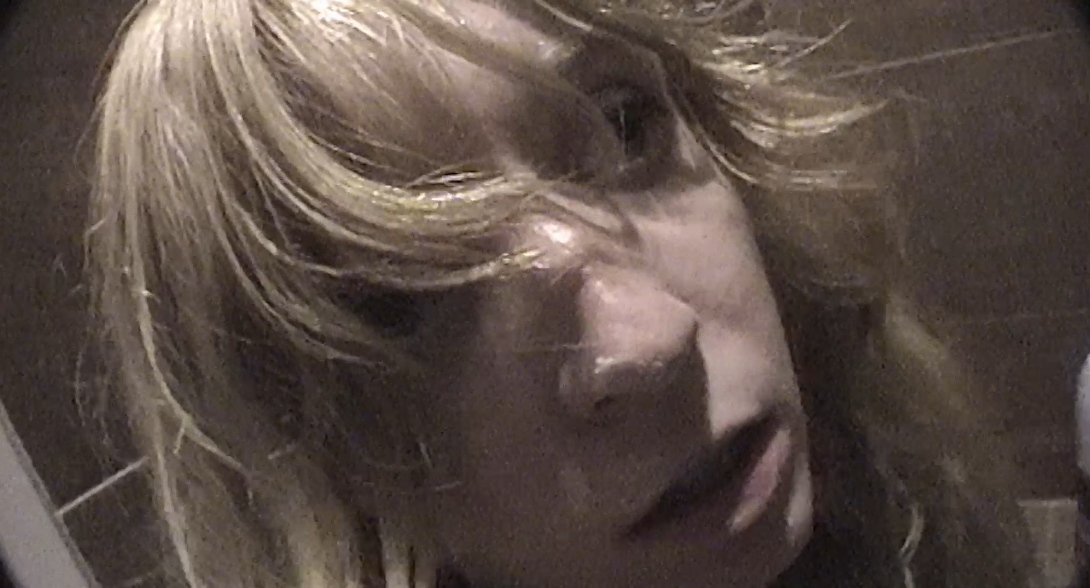
The second chapter closes with Adeline, in a blonde wig, staring dissociated into a bathroom mirror, and this one opens seamlessly with our new blonde protagonist, Circle (Alex Walton), also dissociated in a bathroom, as if the two are sharing a moment—but as we’ll eventually learn, they are on opposite sides of the continent.
Circle, having just snorted a lot of ketamine, returns to what turns out to be a half-hearted orgy set to pounding metal music. A group of trans woman tepidly pleasure each other. There’s a woman on a leash, others doing ketamine off a girls’ stomach. The camera whirls around, dizzying, trying to drum up excitement that just isn’t there. The whole scene is embarrassing to witness—everyone is just soooo out of it.
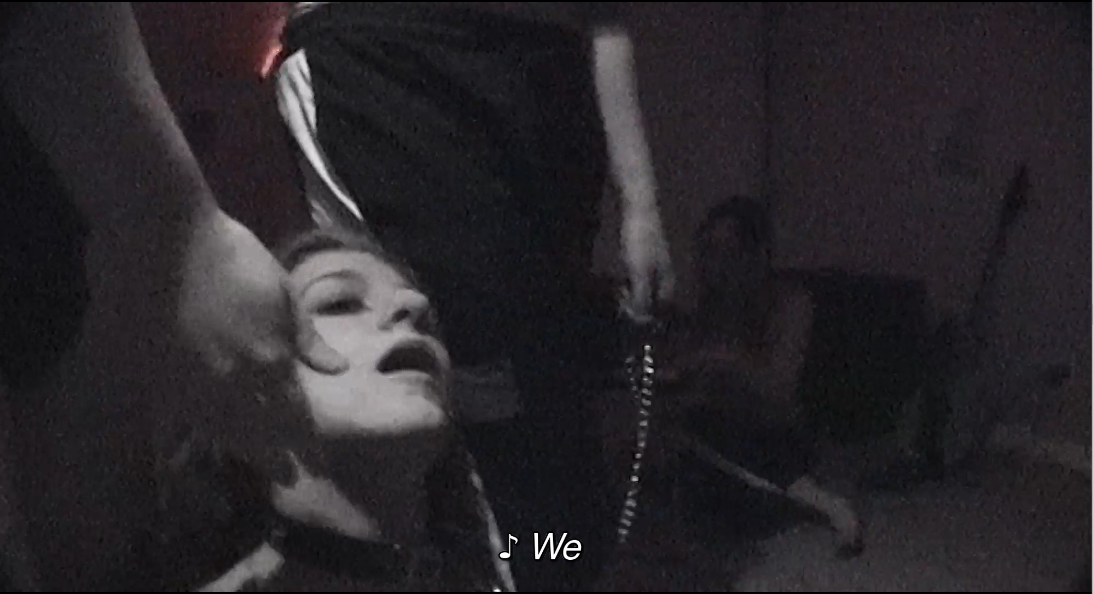
With the sex so strangely off-putting, one begins to notice the other details of the space. Lit by Christmas lights like a college dorm room, it has no windows, suggesting basement. There’s a conspicuous lack of furniture and a set of buckets marked with what look like runes or occult sigils. This is not the sort of sad queer dwelling we got used to seeing in chapter two. What the fuck is going on here?
It appears to be some kind of transfeminine cult, but the details about its formation and leader (eventually identified as a YouTuber named Roxie) aren’t clear. The women here speak of how they flew from the cis world’s indignities to find community with one another. They largely abandon their particular identities and tastes (apart from a few quirks) in favor of uniform wardrobe (tracksuits, of course) and the same food (hot dogs with no bun or condiments) every day. Their ideology is one of extreme passivity, a vicious parody of trans women’s tendency to associate such a stance with an affirming sense of femininity: “If you remove the self that chooses, the self that suffers dissolves.” It’s the ideology of sissy hypno porn raised, with outrageous perversity, to the level of divine command.
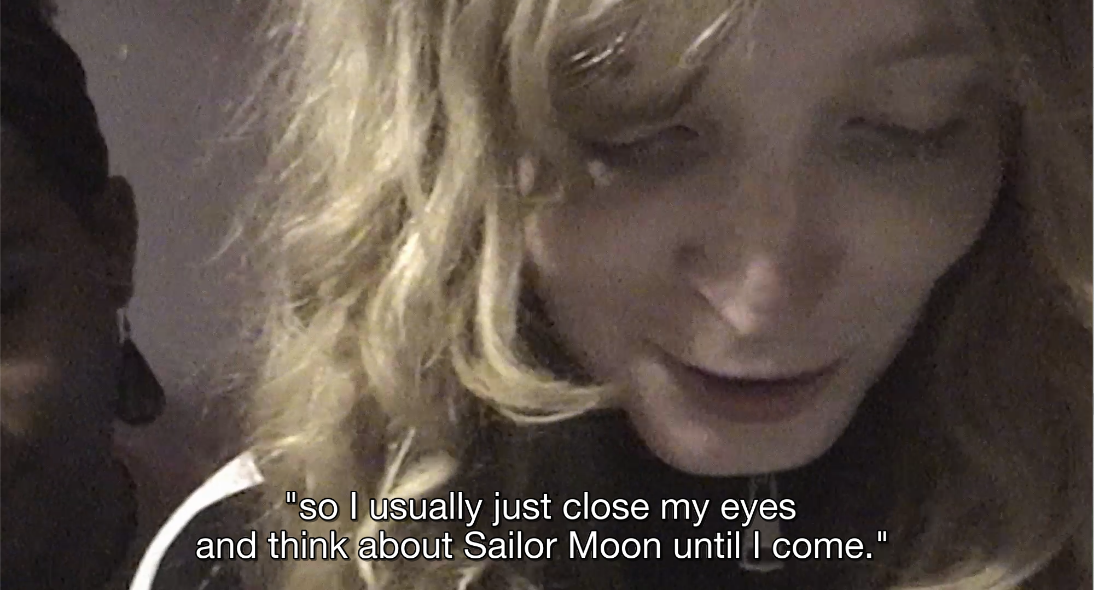
When they’re not having depressing sex with each other, the girls occupy their time with yoga, unbearably woke struggle sessions, decoding 4chan posts like scripture, and one-on-one confessionals with the leader, who speaks to them through a computer—or is the leader a computer? It’s not clear at first. Represented by a weird, floating male head, the Entity they discourse with has a testosterone-affected but gender neutral voice, often sounding more like a creepy, mischievous child than an adult of either sex. He/she/they/it speaks mostly indirectly, dropping strange nuggets of quietistic faux-wisdom, all along the lines of the one I quoted earlier, for the members to contemplate. The group never goes outside, except to find new recruits.
Walton is a highly theatrical singer-songwriter, so it’s not surprising that she’s also a great actor, able to communicate a storm of pain, confusion, and uncertainty, past and present, through body language alone, particularly with her huge and ever-suffering eyes. Her character is very much like her music—disarmingly intelligent, critical of herself and everything around her, buzzing with an unstable mixture of boldness and anxiety. Her exaggerated collapse during a yoga session is funny, pathetic, and sympathetic, pointing to her body and how it is read (or perhaps, the very fact that it might be read at all) as the source of her ambivalence. From the jump, her unhappiness is clear—she even confesses to Meredith (Hazel Norwood) that she’s mulling a detransition— and you desperately want her, for her sake as well as yours as a bored viewer, to get out of a nightmare which I think can best be understood as a metaphorical hell of transfeminine self-loathing.
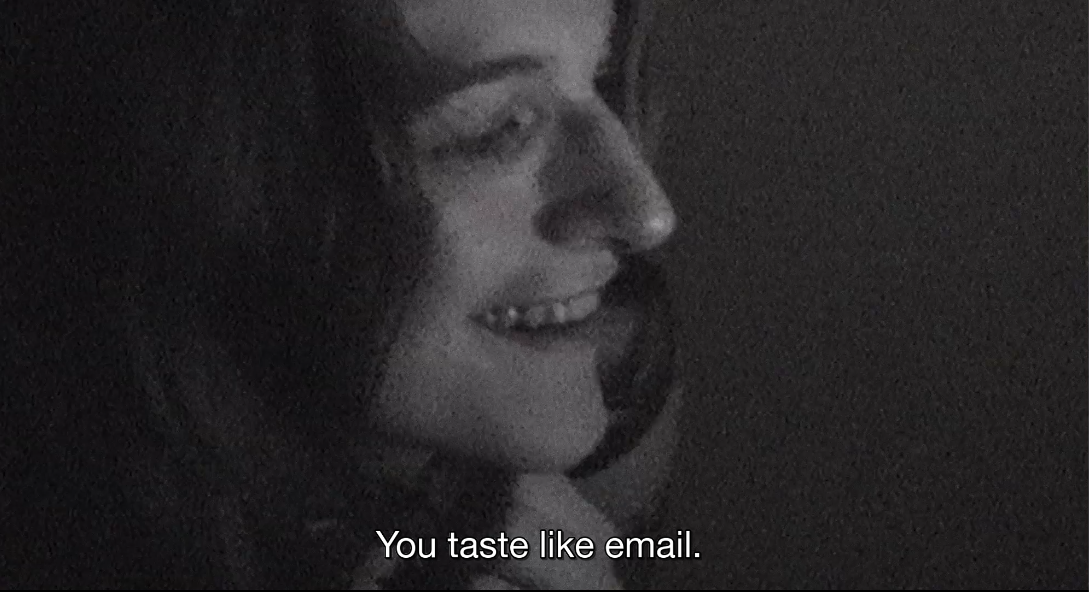
Weard’s signature long takes underscore the tedium of the proceedings—the scene with the 4chan posts is particularly stupid and hard to get through. I started to get really annoyed with these feckless, listless bitches, the same way I do with their counterparts in the real-life online world. Why can’t they get over themselves? Why do they beg for the leader’s approval like sad little dogs (or, in the case of one particularly fargone member, a creepily sexy cat)? But anyone who has assented to punishment long enough to want to even watch a new chapter of Castration Movie knows this exasperation is part of the point.
It’s also an escalation. As heightened from life as the first two chapters were (Weard has described the film’s genre as “hysterical social realism”), nothing in them was was this absurd. The actors occasionally almost break character trying to maintain seriousness about it, but the line is blurry, because many of the cult members themselves seem to think the cult or parts of it are wack, particularly Circle, whose poor adjustment to the group’s lifestyle becomes a source of increasing consternation for the more senior members. But, as Meredith puts it: “This is family. This is it for us. It’s much worse outside.”
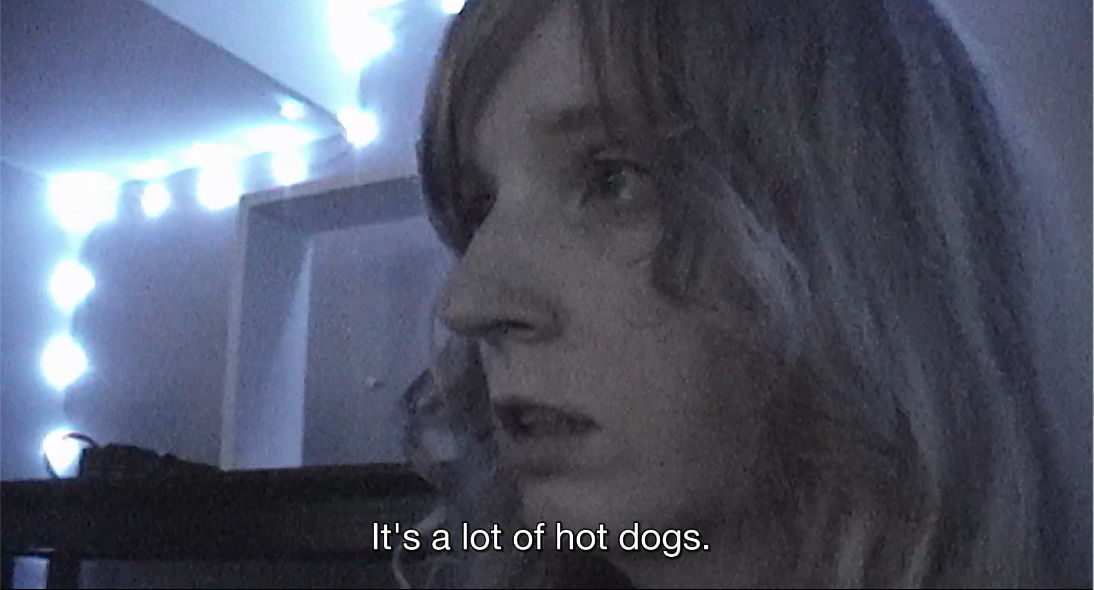
The key to everything may be one of the more absurd details of the cult: their exclusive diet of hot dogs, signifying, in the most delightfully juvenile way, these women’s hopeless fixation on what makes them different from other women, and stigmatized by them: they were born with penises. Every time the members eat, they re-affirm their martyred status1—the notion that trans women are, as the chaser shitposter Halimede puts it, “the women of women.”
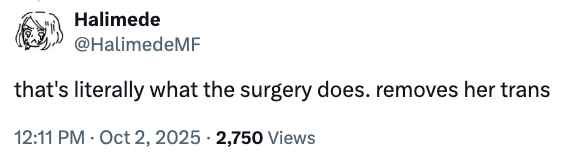
Halimede, like many chasers, cannot abide vaginoplasty, because it “removes [the person’s] trans.” Her neologistic use of “trans” as a noun is telling—what is at stake is not really the penis as an organ, but the patriarchal power those with a penis are permitted to wield. Halimede is right to recognize that what makes trans women both sexually exotic and subversive is how they represent the Oedipal fantasy of an uncastrated woman for the neurotic cis masses—“the best of both worlds.”
The very image of the phallic woman threatens to strike at the heart of the entire social order. If it cannot be made ridiculous and inconsequential by ritual or fetishization (as in drag and porn, respectively), or through exceptional characters like saints, goddesses, and comic book superheroines, it has to be eliminated, not only because the notion that women lack something powerful and dignified that men have is a key justification for patriarchy, but also, on a more immediate emotional level, because of the complex and overwhelming feelings of jealousy and envy the phallic woman prompts in cis people. Trans women unwilling to be relegated to the realm of living fantasy (i.e., almost all of us) are punished, sometimes severely. This makes them like rebellious cis women in many respects, but the difference is that rebellious cis women are seen as betraying their bodily destinies, whereas trans women’s bodies constitute the betrayal itself.
It is hard not to become paranoid as you go deeper into your transitioned life and start realizing that people don’t quite see you as a person anymore. Even if you were used to marginalization and tokenization before, transition will add a grotesque new layer of distrust to your experience.
There are two ways to react to this:
- This sucks, but I’m just going to keep being a human being, seek out the least stigmatizing company I can find, and not let this break me.
- Well, I guess I’m just a FREAK then. Guess I’ll just go CRY in a HOLE in the GROUND.
The second option is cowardly, but fighting is hard and often thankless. Growing up trans is such a bizarre mindfuck and coming to terms with your transness and deciding to transition is so a difficult and risky that we justifiably expect the worst to be over, only to find that a lot of it was actually yet to come. If the cult seems completely unappealing, that’s only a sign that you don’t know how bad things really are out there for us.
Even so, there can be no healing here. Accepting your phallic womanhood in its punished, degraded state doesn’t make the whole stupid patriarchal edifice make any more sense—if anything, it makes it make even less sense2. Left to their own devices, the women of the cult are cut off from anything that might allow them to grow as people: new friends, new experiences, new challenges. The system may be rigged against them, but it’s the only game in town—which isn’t to say that there is no outside to the system, no possibility of liberation, only that the cult is a false one. It’s not even outside—it’s in a basement, even deeper in.
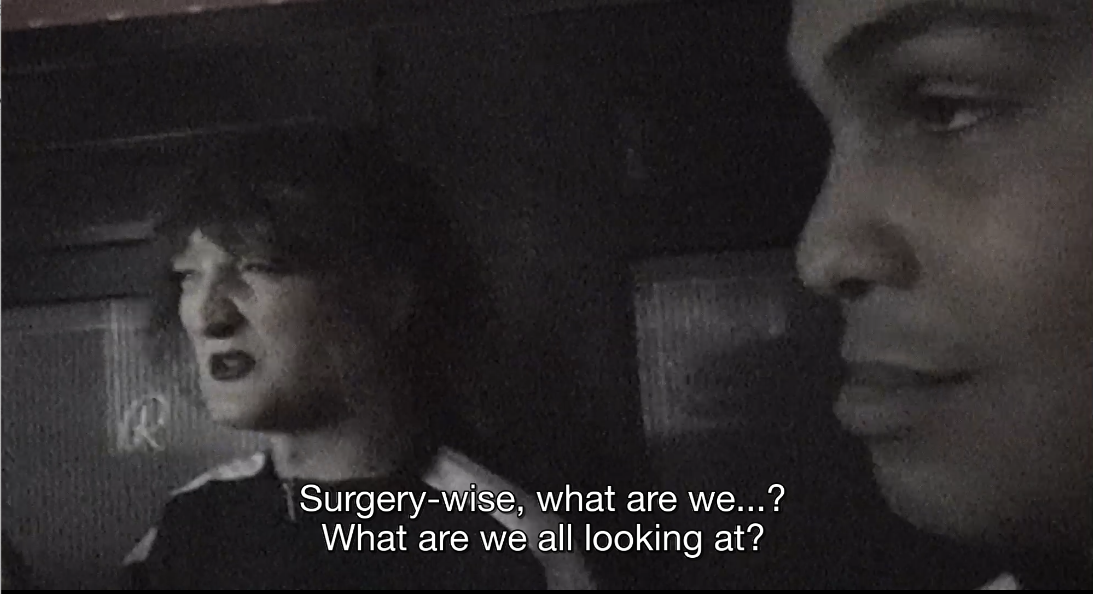
Circle’s inevitable escape is pitched on the razor’s edge of suicide and liberation. She joins a recruitment outing, running off during a strange bathroom humiliation ritual in which the cult members scrutinize prospective members’ surgical goals, hairlines, and, most bizarrely, the strength of their urinary flows while standing up to pee. It’s hard to tell if this is a test of womanhood or a test of manhood, and it speaks to the cult’s inability—or perhaps self-protective refusal—to decide what trans women actually are. It’s at this moment, at perhaps the height of the cult’s absurdity so far, that Circle makes her exit.
She eventually makes it to an apartment, and Agnes Walsh, one of the best known of the current crop of twentysomething NYC dolls, answers the door as Vyckie, an online acquaintance who helped Circle get set up in New York, but only, as it turned out, in exchange for sex that Circle didn’t want to provide. Circle is only here now to get her non-cult clothes, but she doesn’t have an easy time getting out. Walsh projects a distressing mixture of earnest warmth and self-deluded predation in the role—as with other problematic characters in Castration Movie, I felt a modicum of sympathy for her at the same time that I understood why Circle was so anxious to leave. It’s easy to imagine someone like Walsh, who comes off online as beautiful, witty, sexy, and a central character of NYC trans life, seducing and then disillusioning an impressionable, less experienced person like this.
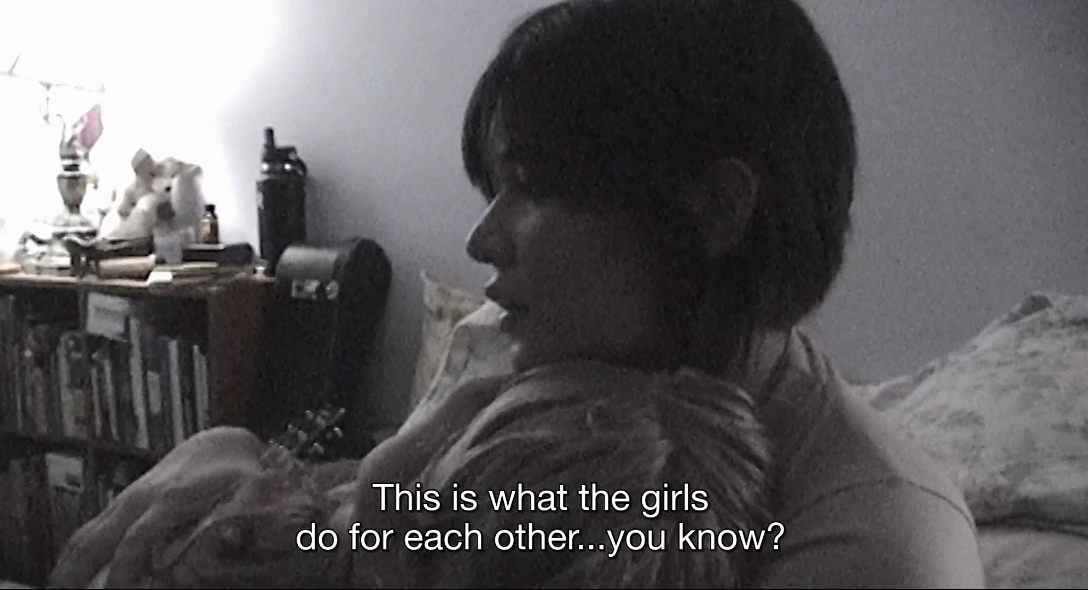
By now, a pattern is emerging: Walsh’s public persona is already a sort of fiction, like everyone’s; as with Walton, Weard then maps a second fiction onto the first. This play between the film’s fiction and the semi-fictions of its makers becomes quite complex, to the point that it’s not worth digging into every microceleb cameo, but the result, for me at least, is a vertiginous feeling that it’s fiction all the way down. We’re all busy all day long inventing and amending fictions about ourselves, the people around us, and the world we live in—we require them to make sense of anything. The foolish person is not the person who succumbs to this, but who refuses to succumb—who continues to seek some shred of “authenticity,” striving to pierce the layered veils of fiction that construct the world. They will find, at the end of their journey, only a hopeless, shrieking void of incomprehensibility.
After rescuing her clothes from Vycki’s apartment, Circle ventures back into the night with no particular plan, eventually attracting the attention of a very drunk cis girl named Natalie (Lea Rose Sebastianis) visiting from Vancouver, BC, who immediately recognizes Circle, in the first and only direct reference to a previous chapter, as looking like her friend Michaela. But aside from being blonde, white, and trans, Circle doesn’t look anything like Michaela, and the observation is just one of many transphobic things Natalie subjects Circle to before she’s finally able to shake her off.
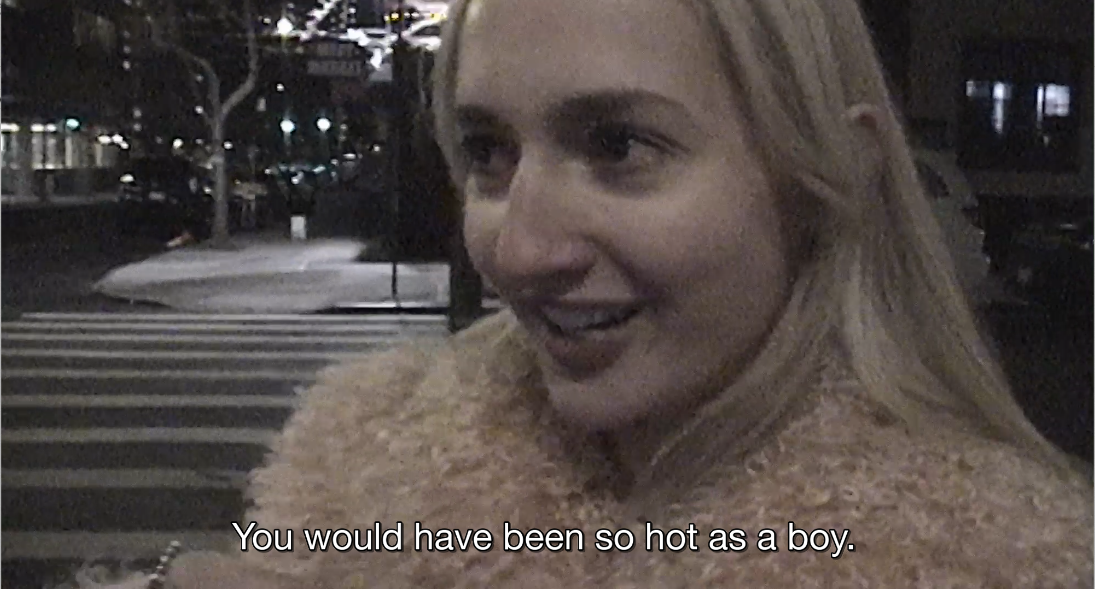
While cis lesbian chasers like Halimede fetishize trans women’s androgyny into a divinely uncastrated status, Natalie, by all evidence a tragically straight woman, stumbles awkwardly inside of the sexual contradiction that Circle presents to her, treating her in one moment like a newfound platonic girlfriend (“I love trans bitches!”) and in others like a guy she wants to fuck (“You would’ve been so hot as a boy… You’d be like, just my type”). Circle’s femininity is sexy to her, but, only if she is actually a man after all. Many such cases…
Natalie, however, is only a miniboss compared to Keller (Ivy Wolk), who we meet at a Bushwick party where Natalie eventually leaves Circle on a couch to brood, and the screen splits between her sitting lonely and silent and Keller holding forth in the kitchen, joking about stuff like being “roofied by a whore,” “Jew tunnels,” and race science (“I think about it all the time. I’m thinking about it right now”). While everyone in the circle she’s talking with—which amusingly includes Vyckie—is contributing to the edginess, Keller clearly enjoys it most of all, and I wondered if Wolk, a hilarious and magnetic cis comic actress and NYC scenester notorious for her edgelord tendencies on Twitter, was intentionally playing with the negative side of her reputation for the camera, or if this is just how she actually is at parties—but then again, Castration Movie is built to expose the meaninglessness of such questions.
The party scene is one of the best examples of Weard’s “long and slow” strategy bringing real rewards. We stay there for enough time that it’s hard to believe the cult even exists—we may as well be in a completely different film, Circle just a socially anxious person brave enough to show up but not brave enough to do much else. The unedited conversation shows us the sort of person Keller is in a way that a more tightly edited one wouldn’t, emphasizing the monotony of her incessant attempts to “spice up” the discourse at hand. It’s easy to get swept into in the inanity of the chat, feeling like you’re with these people, while forgetting that this other person on the left side of the screen has been sitting silent the whole time, just waiting for something to happen.
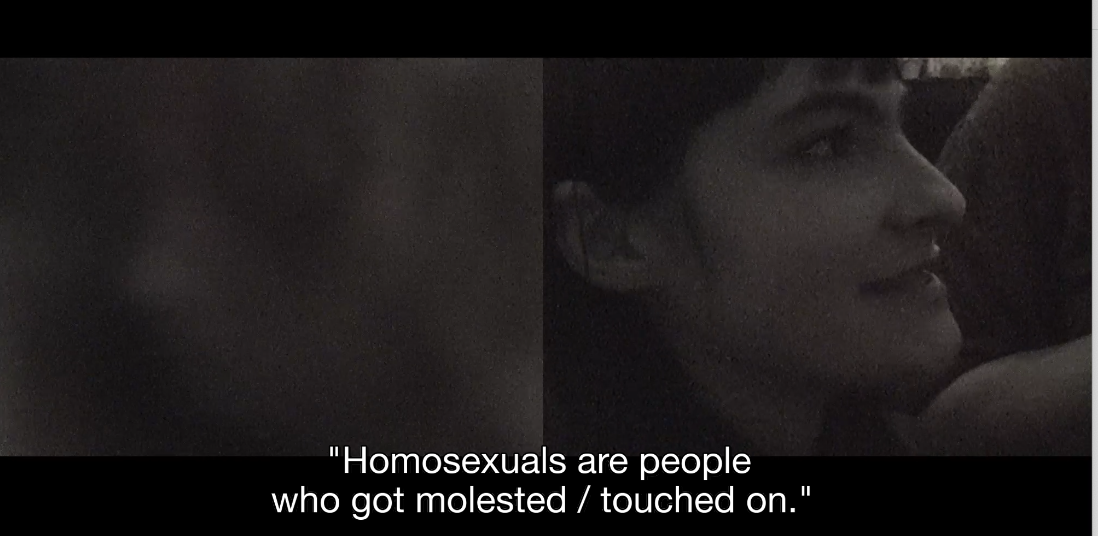
Even when Keller drifts away from the group and meets Circle on the couch, Weard maintains the split screen for some time, emphasizing the lag between these characters’ states of mind. Natalie, having also returned to the couch, asks Keller if Circle would be hotter as a boy, and Keller (who hilariously repeats throughout the film that she “was nonbinary in college”) predictably agrees, even offering Circle a detransitioner name, Luke. Though she was irritated when Natalie originally broached the idea, she seems more open to it now: “Luke’s cool, like Luke Skywalker.” Against the superficially validating but actually manipulative attention of the cult members, Keller and Natalie’s tag-team transphobia feels more authentic. It’s also manipulative, of course, but the manipulativeness is merely horny—unlike the cult, they don’t want Circle’s whole self—actually, they don’t seem to care much about Circle’s self, and for a character who’s been through what she’s been though, it’s probably a relief.
The apparent freedom of Keller’s edginess immediately infects Circle, who starts mocking a guy with prosthetic legs sitting nearby: “That guy’s Robocop!” Keller cracks up at the quip and tries to take a picture, which starts a fight with the poor guy, which is in turn disrupted by Meredith showing up, prompting the trio’s flight from the apartment, and the end of the split screen section.
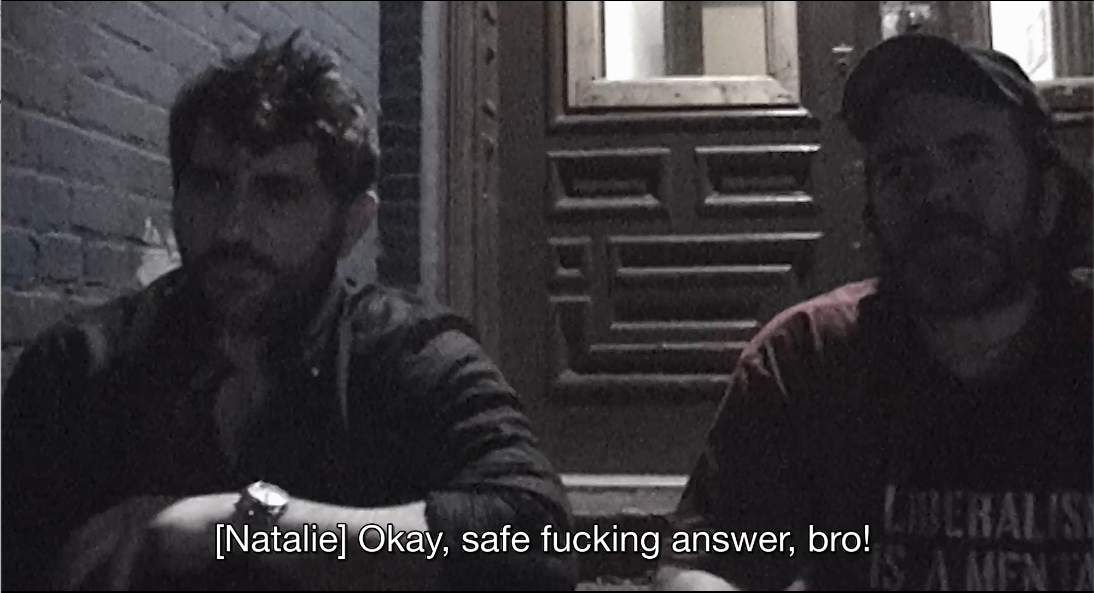
Downstairs, they run into a couple of low-energy millennials played by Chapo Trap House’s Will Menaker and Felix Biederman. Keller subjects them to her own version of a struggle session, trying to get them to admit that Circle looks more like a man than a woman. They put up a strong resistance, because as good progressive millennials, they know the rules—“This is Brooklyn—all women are women”—but they fail to come up with a good justification as to why they should regard this obviously AMAB person as a woman. In their defense, Keller is equally unable to prove Circle is a man, insisting that it’s obvious: “You can’t think for yourselves! You have the woke mind virus!”
The scene feels like a microcosm of the "vibe shift" in hipsterdom that took place sometime in 2021. Keller’s fascoid negging is totally indistinguishable in form from the curdled 2010s hyper-wokeness of the cult. Rather than fostering social cohesion through healthy boundaries between individuals, the intent of such tactics is simply to assert the social power of the person wielding them. Just like the cult members struggle to believe their own rhetoric, Keller knows she’s full of shit, getting positively giddy from using the term “woke mind virus.” It’s ridiculous and beneath her obvious intelligence, and it doesn’t seem like really she gives a fuck either way about whether or not trans women can really be women—she just wants to fuck around with people and get her way. If Menaker and Biederman’s characters seem to have greater integrity, it’s not because they feel particularly strongly either, but because they know that Circle’s gender identity is none of their business. But for Keller and the cult alike, everything is everyone’s business.
Circle plays along, increasingly amused, until Keller and Natalie force her, as proof of her masculine potential, to suck down an entire cigarette as fast as possible, leading to a choking spasm. Many trans women watching this scene will see a painful flashback in miniature of their entire history of attempting to perform masculinity. But something must be changing in her, because even this humiliating moment doesn’t dissuade her from venturing further into the night with Keller.
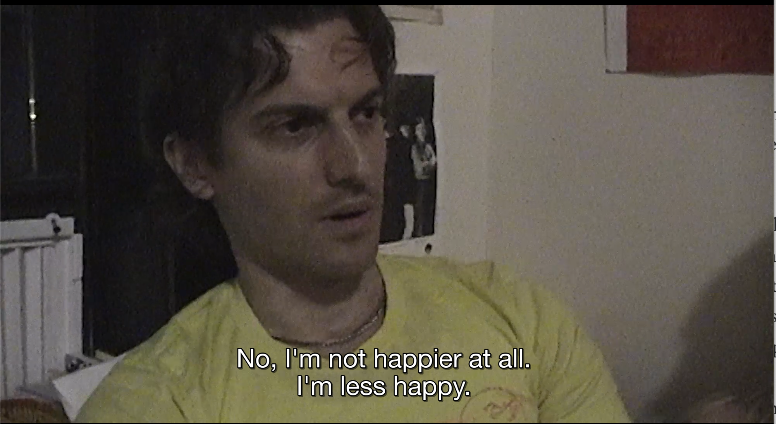
Our next vignette features Peter Vack, another cis NYC scenester known somewhat controversially for starring in the film Actors as an ambition-poisoned actor who transitions for clout. I loved Actors, so I was delighted to see Vack here playing Brody, an older detransitioner who calmly explains his understandable reasons for retreating from womanhood, a decision he considers both lamentable and realistic. Perhaps the closest thing the film has to a voice of reason, Brody is also the only character, and the perfect one, to tell Keller what for: “You suck. Your personality is bad, bro. It’s really bad.”
Natalie, meanwhile, becomes smitten with Brody, allowing Keller and Circle to finally lose her as she decides to stay in his apartment and make out with him. Brody shows his stuffed animals to Natalie and tells her their names—possibly the most transfem way of flirting possible. I really felt the tenderness of his frustrated femininity in this moment. While the combination of his sobriety and her drunkenness prompts some ethical questions, there’s something oddly sweet about the matchup. I’ve come to expect this sort of discomforting ambiguity from Weard, who exhibits a perverse sort of integrity in creating characters whose likability is routinely undercut by their sketchiness.
Circle finally makes out with Keller on the street, getting it all the way to third base before stopping to guzzle down two cheeseburgers, a food she’s been openly craving for the whole film. She performs both acts with the ravenousness of someone who’s just left a religion and wants to do every haram thing they can, leading her to vomit on the street not long after. Even so, it’s decided: she’s going to go back to the basement to get her stuff, meet up with Keller, and never see those fucking weirdos again.
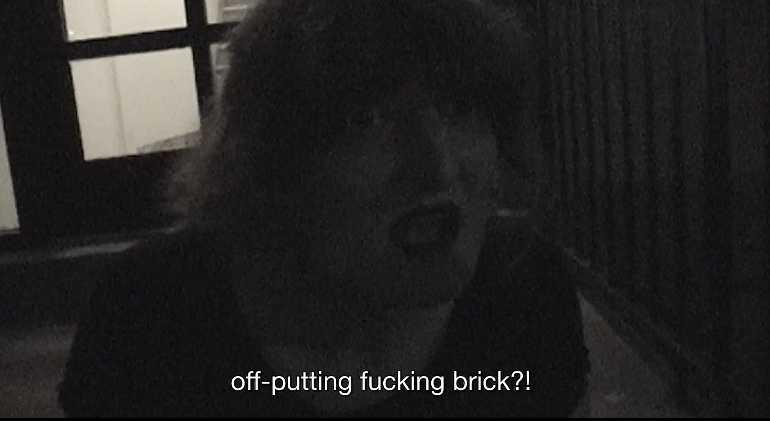
Out front, she meets Meredith, who tries to make her last case for staying, but it quickly devolves into a monologue on her own alienation: “I know I’m the clockiest one down there, and I know my vibes are fucking off… But do you know how much worse it is to be up here, to be on the outside as that off-putting fucking brick?” Hazel Norwood’s mix of vulnerability and defensiveness in this presumably improvised speech is really moving, underscoring better than any other moment in the film the infuriating double bind of transitioning: you either put up with the private discomfort of living as a man or put up with everyone else’s discomfort over you trying to be a woman. It also calls back to an earlier scene in which she’s putting her makeup on before going the recruitment outing, anxiously practicing her femme voice in the mirror and slapping herself in the face when she doesn’t get it “right” enough.
For all the cult’s weird mind games, however, none of them, as far as we’ve seen, has ever called Meredith clocky. Her stress about being “off-putting” seems to be something she took down there with her and can’t let go of—and nothing, not even a hypersensitive t4t polycule, can make you let go of that if you don’t want to. I think the only way out of this double bind is simply to stop giving a fuck and become the woman you want to be instead of clinging desperately to an image of a woman it is impossible for you to be—and if you think those are the same for you, let me suggest that they are not. The resolution to stop giving a fuck, not transition, is the true cure for gender dysphoria, or as close as it gets—transition is just, for most of us, a prerequisite.
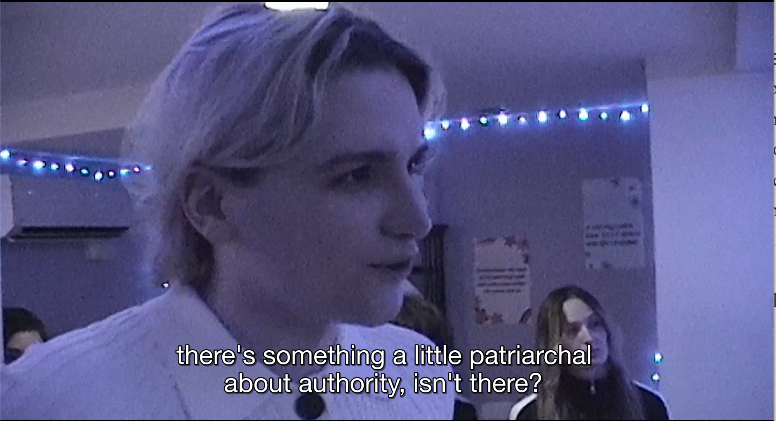
To Circle’s surprise, Roxie is in the basement. She’s played by champion shitposter and Seeking Derangements podcast co-host Hesse Deni, a.k.a. Claire Penis. With over 100,000 Twitter followers, Deni has uncommon reach for a trans woman on the site, and it’s made her an influential figure for many. I can think of a few people whose particular status makes them great picks for Roxie, but she’s definitely one of them.
Unfortunately, Deni doesn’t quite deliver here. Although she’s amusing in several moments, her main affect in the role is smarm, and I found it hard to understand how she might have seduced all these women to the extent she has. To be fair, though, Roxie has been built up so much by this point that the role, relatively brief in the context of a five-hour film, would be a challenge for any actor, and none of this distracts much from the bizarre scene that unfolds.
Before we know it, Circle (tricked in a very funny contract-signing scene by Roxie’s scene-stealing lawyer) is forced to strip naked, then shoved into a puppy crate and subjected to an MK-ULTRA-style abuse session. The cult’s usual passive-aggressive language of “accountability” and “family” begins to collapse into the sadistic, authoritarian hostility that has always been its secret underside. Circle starts to crack, screaming, begging to be let out, but the cult just keeps needling her, dropping hot dogs through the bars of the cage, repeating everything she says, etc., all while maddeningly alternating between gentle and hateful language.
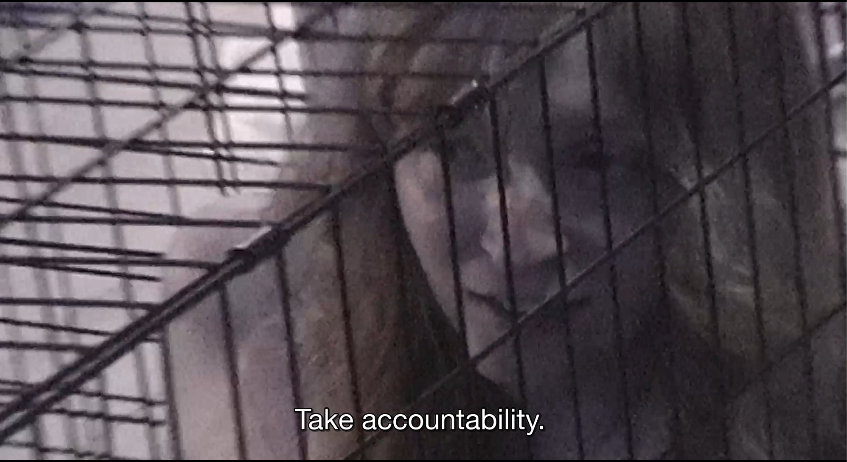
The scene’s resonance is a little hard to describe. Like many of the most traumatic moments in Castration Movie, its sheer excess makes it uncomfortably funny without it ever completely becoming a joke. At the same time, like the rest of the cult’s activities, it’s sort of boring. Even during this peak experience, the members seem too dulled by their fear of direct aggression to be truly scary or to vigorously defend the cult when it’s being seriously undermined. Without the anonymous shield of the Internet, dogpiling looks about as pathetic as it really is.
There are other factors, of course, but this dulled aggression is, I think, a big part of the reason why it was so easy for the anti-woke mob to gain the upper hand: they were willing and able to back their point of view with real-life violence and bankable threats. In a few short years, the passive pseudo-progressive postures of many universities, corporations, government agencies, and media entities have evaporated, not often by real force but simply because few in positions of influence and/or power really had an incentive to defend social progressivism when push came to shove. The mainstreaming of social justice discourse in the 2010s was, for the most part, a bluff, a fashionable posture with no real relation to emancipatory politics. The same is true for Keller and the “Dimes Square” mentality she represents, but the difference is that the people Keller is siding with (however ironically) have most of the money and guns—and, presently, control of the federal government3.
In the background of the crate scene, the computer through which Roxie used to speak (maybe? sometimes?) is heard endlessly repeating “Conflict is not abuse. Conflict is not abuse. Conflict is not abuse.” This slogan was originally coined as a corrective to leftoid communities’ perceptions of disagreement as inherently threatening and aggressive; it’s also the title of a controversial 2016 book on that topic by cis lesbian writer Sarah Schulman. Here, however, it is twisted to justify the cult’s actual abuse, demonstrating that there is really no ideological way to avoid the dark side of community—every useful intervention can be captured and neutralized until it feels like the opposite of what it originally meant.
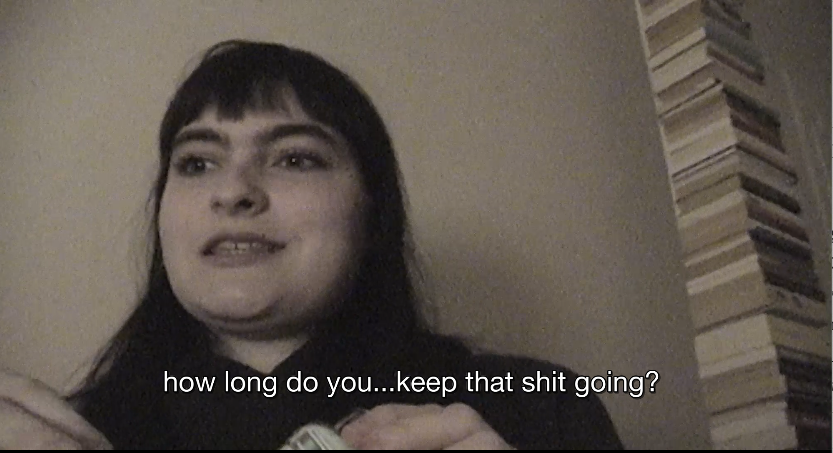
Keller, meanwhile, is having an evil heart-to-heart with her friend Izzy4, who we’ve seen already as a friend of Turner in the first chapter of Castration Movie. She tells Izzy about Circle, describing her consistently as a guy and sort of proudly explaining how she seems to have pushed her detransition curiosity to the breaking point: “I saw something change in his eyes,” she says. “I think he realized that it could be a viable option.” We also saw that shift in Circle’s eyes, but Izzy and Keller talk as if it’s simply assumed that transition is impossible for everyone. “It’s not gonna last forever,” Izzy says. “No,” Keller agrees, “It’s untenable,” and they both erupt with mischievous laughter. As in the scene with the Chapo guys, this laughter gives me the feeling that this is less about conservative convictions than than simple enjoyment of gatekeeping womanhood. When Keller describes the cult to Izzy, Izzy says she’s heard of it and that it’s actually super sinister, prompting Keller to resolve to rescue Circle.
Back in the cult, things begin to fall apart. Circle suddenly recognizes Roxie as “that fucking pedophile.” She’s right. As it turns out, Roxie is a cancelled groomer for whom the cult is a means of anonymously continuing her predations. No one seems to believe Circle at first, allowing a rattled Roxie to escalate Circle’s torture ritual by handing her a gun and offering to let her commit suicide instead of rejoin the cult. But one member, Valerie, eventually pieces everything together, pouring a bucket of semen (I think?!) all over Circle in fit of emotional turmoil, just as Keller arrives. Keller takes the gun out of Circle’s hands, and although one of the cult’s senior members manages to grab it back, the ensuing confusion allows Keller and Circle to escape. One by one, each of the members becomes disillusioned and makes her exit—except Devon, the most faithful member, who has to be convinced by Roxie herself to give up.
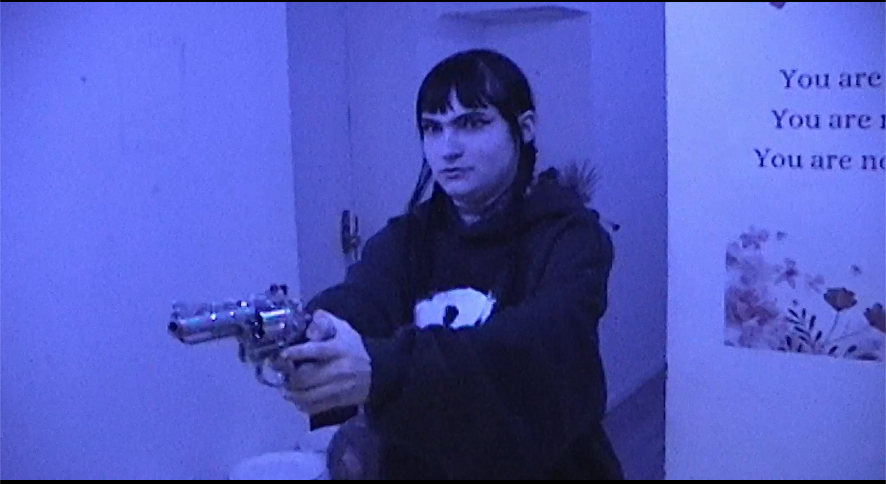
All of this happens pretty quickly by Castration Movie standards, and for a climax, it feels a little muddled, even if it’s still very funny. In this and other moments, I’ve wondered if Weard’s ambition for the film had outpaced the limitations of her mixture of actors and non-actors, reliance on improvisation, and commitment to long takes. On the other hand, these lapses into artlessness fit with the film’s metatextual exploration of nested fictions—this is a movie that has never been particularly afraid of admitting it’s a movie.
Besides, the cult has always been so pathetic and annoying that you can only imagine it going out with a wimper rather than a bang. Chekhov’s gun never goes off—and what could be a more fitting conclusion to a story which has been, in large part, about the psychosexual politics of power?
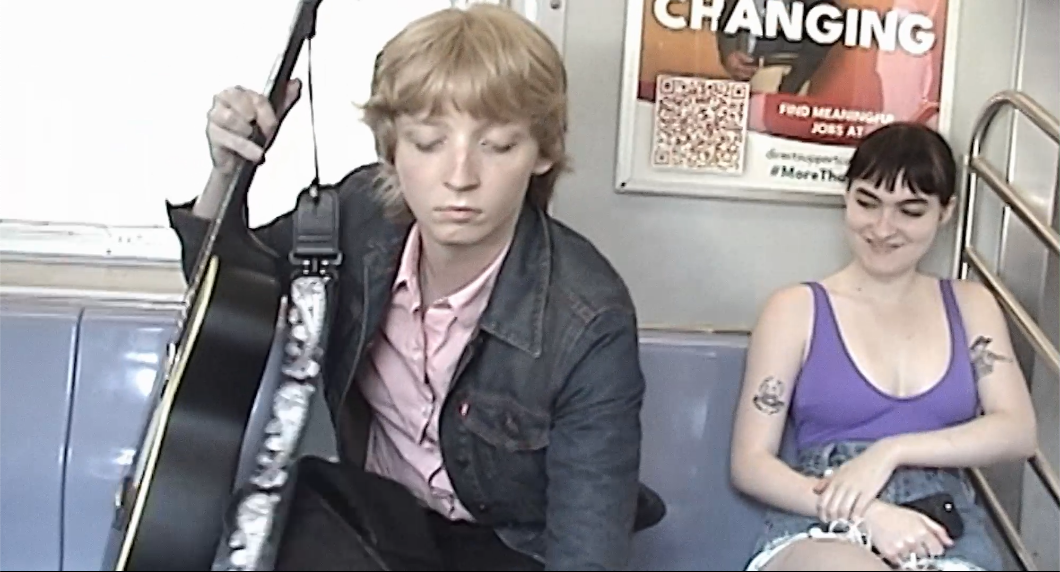
Weard reserves the true audacity not for the film’s conclusion, but for its epilogue, which shows a detransitioned Circle (perhaps I should call him Luke now) on the subway with Keller, performing the hymn “Let the Circle Be Unbroken” on acoustic guitar while Keller adoringly films him. It’s a lovely performance, and there’s something idyllic about the whole scene. The subway train, running on what looks like an elevated rail, has sunlight pouring into it—the complete opposite of a basement. The pair are clearly a couple now, and they both look beautiful and young and “world is their oyster” and all that. I’m not gonna lie, folks—it’s charming as fuck.
If anything, it’s a little too charming. Not that detransition isn’t right for some people, but this struck me on first watch as a strangely conservative ending—one of the trans people I was watching it with, who’d grown up Mormon, said he was put off by the presence of a Christian hymn, with its lyrics about a better life “in the sky,” and I think he was right to be put off. It’s hard to believe this relationship has any legs. Throughout the chapter, Keller has fetishized her ability to shepherd Luke into detransitioning; Luke has jumped more or less right into Keller’s arms after exiting a deeply traumatic situation. Even if he really did want to detransition, Keller would be an unhealthy person to do it with/for, notwithstanding the genuine affection she has for him. How are we supposed to just accept this “happily ever after” shit from a film with such a sharp understanding of relationship dynamics?
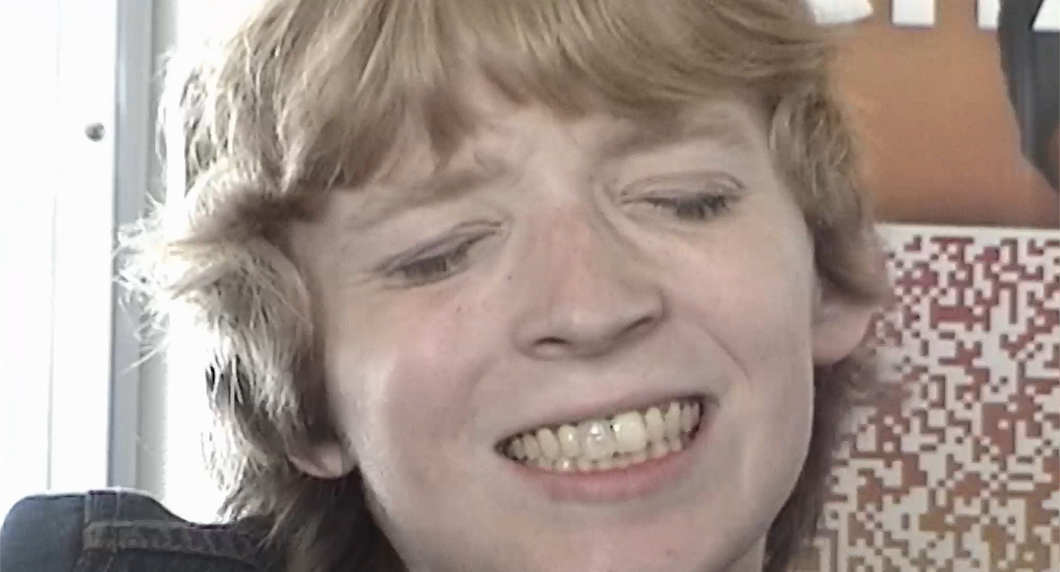
Maybe we’re not. On second watch, I noticed Luke’s exaggerated wince at the end of the song, and the way he stretches out the second-to-last chord of the song, as if he can’t quite stand to finish it. Singers make painful faces like this all the time when performing, but it struck me here as a sign. While subtler, it has a similar effect to the ending of The Graduate: these two have gotten what they want, but now what? Perhaps that wince is Luke realizing he has no idea.
One of the toxic dimensions of trans culture is that it tempts you to think everything comes down to gender: figure out your gender, maxx it, and happiness will follow. In the cult, trans women obsesses over their transness to the exclusion of everything else; Luke’s detransitioned life represents the radical rejection of that obsession, to the point of rejecting trans womanhood entirely. Has Luke been failed by “the trans community?” Kind of—the cult at least is deeply fucked, and Vyckie was a creep, but there are plenty of relatively normal trans women out there (even if none of them are in this movie). Is this Keller’s fault for toying with his confusion? Not really—at the end of the day, she’s just a little gremlin, and kind of heroic in a fucked up way, and don’t we all have a fucked up little agenda for our partners? Isn’t that part of love, problematic as it can become? She and Luke will probably break up in the near term, but he may not regret the decision she helped him make. Maybe there’s nothing sad about it—just a person exercising their freedom of self-determination in less-than-ideal conditions. Isn’t that what this whole transition thing is supposed to be about? And if so, how can there ever be any certainty in it?
Gretchen Felker-Martin, incidentally, incorporates a similar theme in her novel Manhunt, in which her post-apocalyptic trans woman heroines paradoxically maintain their estrogen levels—necessary to avoid succumbing to a disease that attacks people with significant testosterone—by consuming men’s testicles. ↩
The cult, incidentally, is named Polygon, evoking a crude, sharp-angled approximation of a three-dimensional figure—a bogus, computerized simulation of real life. ↩
Weard alludes to this in the opening credits, which run over a video of Donald Trump babbling to the press while signing executive orders. None of it seems to have anything to do with the movie, until the very end, when Trump is presented with, in his staffer’s words, an order for “Protecting women from radical gender ideology.” “Ooh!” Trump says, signing away. ↩
Izzy’s trans skepticism is already known to fans of the film from a painfully hilarious scene Weard has shared from the next chapter, in which she reacts very negatively to her boyfriend coming out as a trans woman. ↩