I Saw the TV Glow... and All I Got Were These Bad Vibes
Jane Shoenbrun's trans-coded psychedelic psychodrama is a masterpiece of atmosphere, but it's also a solipsistic bummer.

Warning, cowards: massive spoilers follow
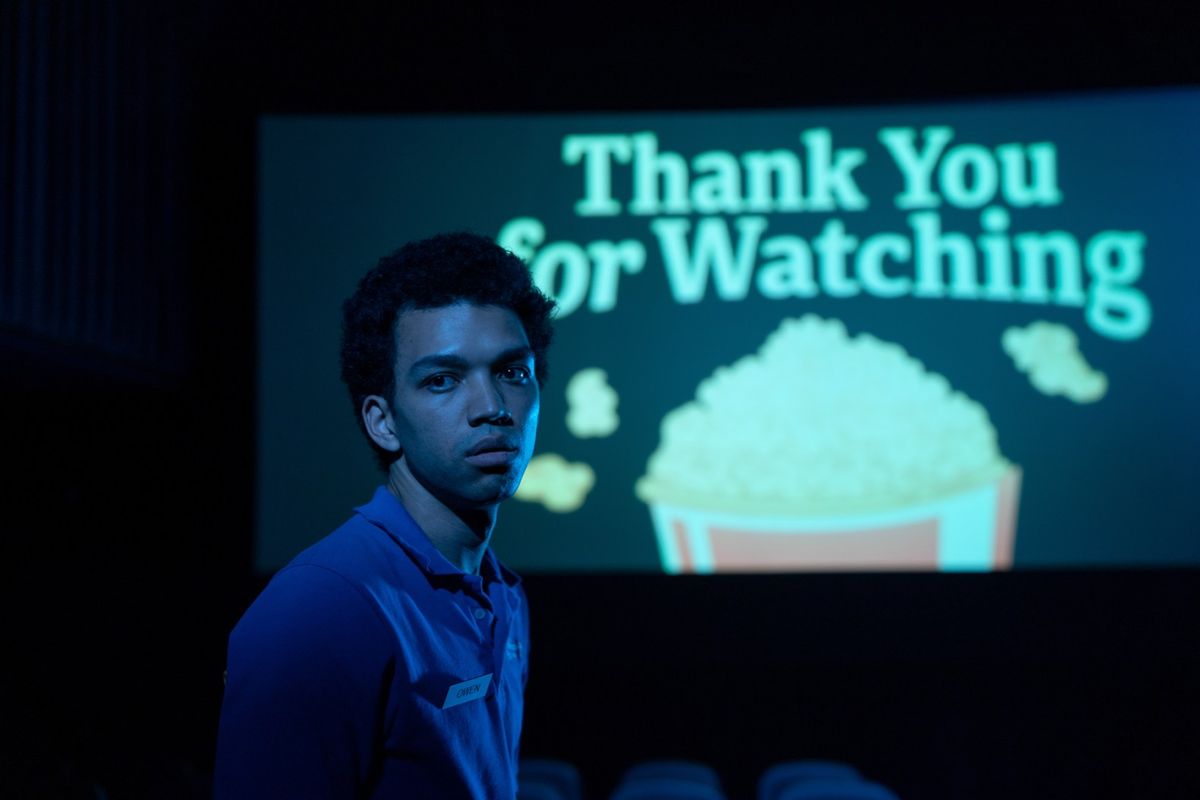
It was rough out there before Tumblr. Like the I Saw the TV Glow’s protagonist, Owen, as a trans kid growing up in the 90s and 2000s, I had no fucking clue what was “wrong” with me. To say I was in denial would imply that I was lucky enough to even know what transness was, and that I could transition. I was just confused and scared and I went through long periods of isolation and desperation, totally uninterested in doing anything but, yeah, staring at screens. In many ways, I tried to be nothing and nobody. There were many parts of the film that felt like a knife to my heart, or, more accurately, the knife that was already in there. It was relatable to the point of making me feel really, really bad.
TV Glow, at turns gorgeous and grotesque, but always visually and sonically on point, is incredibly effective at depicting this mood—the trouble is that it doesn’t have any other mood. Writer-director Jane Schoenbrun is pitiless toward their protagonist, Owen, who remains, in the 4chan trans board’s parlance, a “repper”—someone who knows they’re trans but refuses to transition, desperately trying to make their AGAB work for them. The film operates basically like a Jack Chick tract where a guy rejects Christ and then goes to hell, and in the last panel he’s burning and the text says “There’s still time to save your soul! Get a Bible (King James Version)! Give your soul to Christ!”
Owen’s failure to change appears to be mostly due to social isolation. He has a single friend in the movie, Maddie, with whom he isn’t even really that close. Mostly, they just watch The Pink Opaque, the show-within-the-film (essentially a more twee version of Buffy) together. Maddie’s father is abusive and scary; Owen’s mother is sweet, but she dies, and his father is not emotionally available or interested in his son. He dies too, eventually. Along with another friend of Maddie’s, who quickly disappears after a botched come-on from Maddie, and the dickhead guys Owen works with, these are pretty much the only characters in the movie. The anonymous suburban setting is comfortable and quiet, but eerily empty. Before Maddie, Owen seems to have no friends, and neither character makes any others that we see, or does much of anything except look forward to the next episode of the TV show. Until Maddie runs away from home, both their lives are defined by alienation and inertia.
Part of the reason things are like this, as we eventually learn, is that this world isn’t actually real—it is a false world within the universe of The Pink Opaque, to which both lead characters have been banished by the show’s villain, Mr. Melancholy, who wiped their memories and gave them false bodies and identities. Actually, it’s not clear if, in this universe, there even is a real world, or if the film is metafiction gesturing towards its audience (to whom Owen frequently speaks, Zach Morris style) as the inhabitants of the real real world, with the protagonists as partially self-aware characters trapped in two layers of fiction.
All of this is intriguingly similar to an episode of Buffy called “Normal Again”, in which a villain’s poison causes Buffy to believe she’s in an alternate reality where she dreamed all the vampire slayer stuff up. But as a trans allegory, the more germane reference is to The Matrix—another film in which an implicitly transfeminine character discovers their reality is false, and their identity fake. But, bizarrely, TV Glow inverts The Matrix’s premise—it’s the simulated world, that of The Pink Opaque, that proves real, and the “desert of the real”that turns out to be the simulation.
The film proceeds according to this backwards logic. The only way for Owen to be free is to bury himself alive with Maddie—to commit what appears to be suicide. Only then will he wake up from the dream he’s actually been having and realize that he’s one of the girls from The Pink Opaque.
There’s something startlingly solipsistic and weirdly transphobic about the implication that accepting your transness is about rejecting reality, because reality hates you and has no place for you—and, moreover, was constructed entirely to torment you and your other misfit friends—and that the answer is to completely immerse yourself in your own fantasy world. What appears to be a stylish, morally stark condemnation of the hollowness and conformity of middle class American life turns out to be something quite different: a Disneyesque fantasy of “making your dreams come true,” curdled by age and frustration into a full-blown denial of reality.
I just don’t agree with this presentation of transness and transition. To me, for a trans person, it’s our cisness that’s the fantasy, which, for a time (in some cases, sadly, our whole lives) we struggle to make real in the face of the inevitability of our own inclinations. Accepting that you’re trans means giving up on the dream of being cis—not only the dream of being cis according to your assigned gender, but also according to the gender you actually identify with. It’s about finding a way to become who you want to be in this (mostly transphobic) world, with the body you have and the means you have available.
Furthermore, the stakes of transition, as presented in TV Glow, aren’t typically so stark—nor is there such a strong division between pre and post-transition life. Sure, it’s true that all pre-transition trans people are to a greater or lesser extent “living a lie”, but their life is not a false one, and it does not magically vanish like a spell breaking when they actually do transition. As mind-blowing as it is to realize you’re trans if you’ve repressed it heavily (and believe me it is), turning the decision to transition into a decision of fundamental moral and epistemological concern is overselling it. In another recently-released trans film, Stress Positions, Theda Hammel’s character offers a much more sane explanation of the shift: “I wanted to kill myself, and [transitioning] sort of helped.”
The suburbs are a creepy place, but they’re not this creepy. There’s still life, and there’s some escapism to be found even for alienated freaks held within its conformist constraints. For fuck’s sake, I was thinking, looking at Owen, get this bitch a Magic card deck and send her to the game shop! At least get her on the Internet, which doesn’t seem to exist at all in the world of the film—a choice that feels increasingly strange as the timeline, which begins in 1996, moves closer to the present.
To be honest, it’s understandable why Owen doesn’t choose to escape the false world and return to his “true” life and body—nothing he’s experienced has ever convinced him there’s anything better. Why should he believe his wide-eyed, quietly fanatical friend, who never even tried to call him when she was away all that time? Why choose life when the closest you’ve ever been to being happy (or at least morbidly preoccupied) was being glued to a TV show? There’s something gruesomely sadistic about the film’s third act, in which our hero is effectively punished for failing a test he was never really set up to pass. If this is supposed to be the fault of his environment for not being queer-friendly enough, I don’t think that comes through strong enough—it’s mostly framed, very much, again, in this conservative evangelical way, as Owen’s fault, individually, for refusing to believe Maddie.
I Saw the TV Glow suffers from a problem that Buffy and the other series alluded to via The Pink Opaque never did: it has absolutely no sense of humor. The genius of Buffy was to create something both knowingly campy and morally serious, in which a character like Spike can be a lovable punk and a menacing sociopath, where Xander’s embarrassing horniness or Willow’s charming geekery can break up moments of high and genuine tension without the tone ever feeling inconsistent. It worked, in short, because it felt like adolescence does: high highs, low lows, and an almost medieval struggle between dualities: good and evil, adult self and kid self, boy and girl, parent and child, freedom and restraint, excitement and fear, confidence and self-loathing. There’s simply nothing dynamic in the world of TV Glow, no signs of love anywhere, only desperation.
Most of us look back on our teen years ruefully, and with good reason, but have you ever loved music as much as you did back then? Have you ever felt so close to your friends? Have you ever felt the joy of pure infatuation to such a degree? Have you ever been as excited to get behind the wheel of a car? These are ultimately the experiences that draw us into adulthood, promising new joys and liberties, the hope of a life set more on our own terms. If every trans teen felt as bad all the time as Owen does, almost none of us would survive, and the truth is, no matter how repressed we are, most of us do survive, even if things can get pretty rough. We may not really start living the life we want until we transition, but most of us do our best to find some way to enjoy ourselves sometimes, however compromised that enjoyment may be by the dysphoria gurgling and roiling beneath the surface of our experience. This, I think, is what we really need depicted in trans cinema, and TV Glow, as fantastic a watch as it is, isn’t the place to find it.
Don’t get me wrong, I would recommend this movie, especially to other trans people, as an eerie, immersive experience worth having. I was glued to it the entire time. But don’t let yourself get seduced by the film’s solipsism—it’s really bad for you. Knowing me, TV Glow would’ve scared me shitless and confused me more if I’d seen it around the time I was first seriously questioning whether or not I might be trans, and I’m not totally sure it’s an emotionally safe watch for certain other questioning people, despite many reports of it helping people decide to transition.
But to say this, in some ways, is only to admit its artistic power. I Saw the TV Glow seems destined to be a touchstone of trans cinema for years to come, and I hope its success will allow more trans filmmakers to see their projects to fruition, leading to a greater diversity of artistic perspectives.