The Comfort In Being Sad
Could Kurt Cobain have been a trans woman? The question probably matters more than the answer.

I was born in 1986, so I was just a little kid in the 90s. It took me a while to get into music, but Kurt had me the first time I really listened to the song “About a Girl”—so pretty! So spooky! The harsh melodicism of it all! This was the coolest thing I’d ever heard.
Throughout the rest of the 2000s, while third wave emo, like the grim reaper, was busy at its task of destroying what remained of “alternative rock” as a mainstream genre and overeducated indie bands were luring my fellow millennials into a false sense of smugness at the height of the Iraq War, I kept the torch burning for the great indie/alt rock songwriters of the 80s and 90s. My hipster housemate played Brian Eno and LCD Soundsystem on repeat; when he was away, I dropped my precious vinyl copy of Nevermind on the turntable and rocked the fuck out. I wanted to learn everything I could about Kurt. We were not very similar people—I was a lot more like Rivers Cuomo, sad to say—but he was like a parasocial older brother to me—and how many others?
So of course I was very amused and intrigued, when I began unearthing my transness, to learn that Cobain is widely believed online to have been a repressed trans woman. Know Your Meme is an ad-choked website, sorry, but that link probably provides the best summary of this lore, which has the quality of a creepypasta (trannypasta?). Its essential elements have tumbled across social media, forums, and thinkpieces for several years, like a dead leaf in the wind.
Cobain is not the only dead (ostensible) man to be subjected to this treatment, but his example is probably the best known and most discussed. I will not go through all the biographical facts and quotes used to make the case here, but yes, there is a lot of evidence that Cobain, despite never officially identifying as any sort of queer person, was unusually reverent toward women and femininity for a cishet man and acutely uncomfortable with his social position and embodiment as a man. These traits weren’t just a private issue—they were very much, and increasingly over time, a part of his lyrics and public persona.
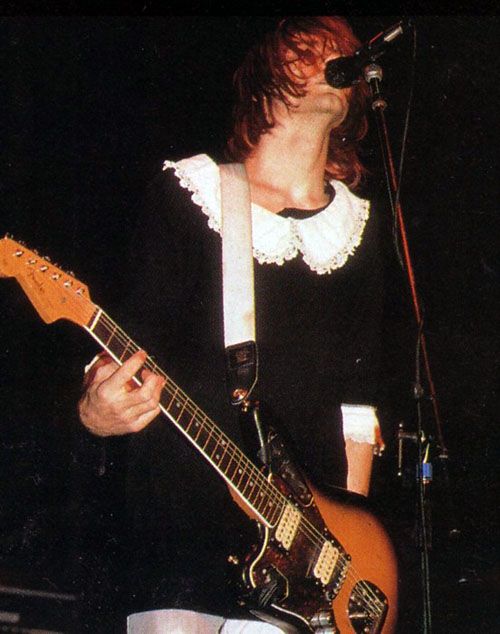
As I’ve said elsewhere, none of these preoccupations can make someone a trans woman—only coming out and transitioning can do that. The question of whether or not Cobain “was trans” is, I think, not a question meant to be answered, just asked. Only he could have answered it definitively, and despite all the trans-baiting comments he made, we have no confessions from him desiring to transition or even seriously considering it. Even that enfant terrible Jennifer Coates, about whom I wrote a couple posts ago, went further than than he did, at least admitting she was trans. Certainly he knew about transsexuals, and he enjoyed cross-dressing occasionally, on stage and in private, and performing other acts in solidarity with queer folks, like kissing his bass player on national TV. The thought probably crossed his mind, but everyone knows how his story ends.
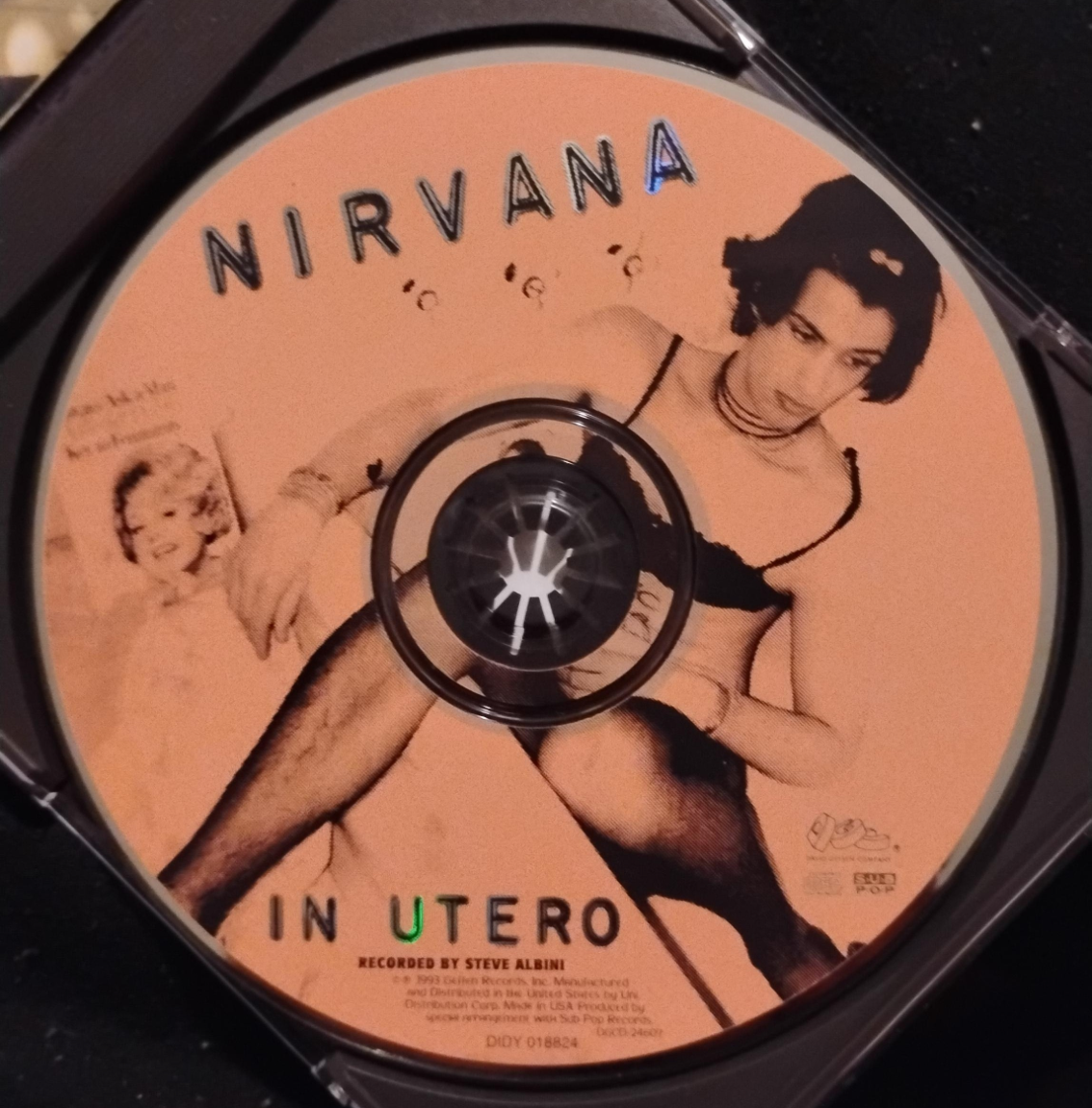
Speculations about Cobain’s transness are perhaps at least partially rooted in another, far more troubling question: why did he kill himself? We can’t help but ask this question about suicide, even though we rarely find a satisfying answer, and Cobain’s suicide is one of the most famous in living American memory—arguably the most famous suicide of the 90s, especially for those who were around his age at the time—Gus Van Sant even made a whole (ill-advised) film imagining how it went down. Cobain’s artistic legacy is titanic enough that his suicide never completely overwhelms it, but people still usually read his work—especially Nirvana’s final album, In Utero, whose transfem-compatible energy comes in hot and heavy—with suicide as its inevitable end. Cobain is to subsequent indie and alt rock what the teenage poetry wunderkind Thomas Chatterton was to the Romantic poets of the early 19th century: the brightly burning talent who was Too Pure for This World, an endless source of doomed inspiration to his antecedents. Sappy indeed—any fan can attest that he’d never have stood for such hagiographic nonsense, but, in a moment of profound weakness, he opened the door for it.
As a monolithic explanation for his suicide, being secretly trans has an obvious appeal, but no more than other simplistic theories: he had a bipolar disorder diagnosis (according a relative), he couldn’t “deal with the fame” anymore, he had crippling stomach pain from wearing his guitar in a funny way, or—worst of all, most notorious, and utterly meritless—maybe Courtney murdered him. Thought not equal in plausibility, theories are united and interchangeable in the sense that they all serve to cover over the disturbing void of meaning in the wake of suicide—the same void of meaning that is often felt by those contemplating it, then passed on, in the wake of a successful attempt, to everyone who cared about them.
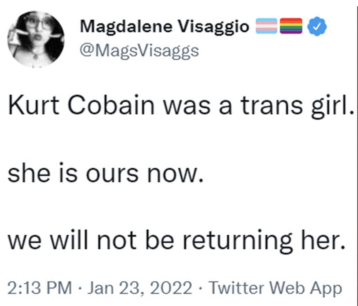
Trans women are also attracted to the “Kurt was trans” theory for trans-specific reasons. Kurt represented (inaccurately, but popularly) the grunge genre, which, sensitive as it was, was still a very masculine genre, full of grunting angst, down-tuned guitars, and grim subject matter. The idea that its poster child might have preferred womanhood cuts against popular expectation for trans girls as obviously effeminate boys, reinforcing the correct notion that any apparent boy, no matter how male-coded his interests and bearing appear to be, could be a trans girl. Despite his statements and lyrical imagery, Kurt never seemed particularly feminine so much as a dyspeptic beta male hiding his alpha looks and ambition behind stringy hair and several layers of flannel. If he hadn’t told us, we wouldn’t know, and that’s the way most trans women’s pre-transition lives actually are.
Kurt was also a highly accomplished rock artist, cutting against another stereotype—that of trans women as creatures of STEM and geek culture, at least for those who see us having any other social position than sex worker. Kurt’s image is that of an outcast, but not a geek—he’s sexy, mysterious, taciturn when not singing, and “just woke up like this” fashionable. He’s not the kid who’d rant to you for 15 minutes straight about some anime—he’s the kid who’d get in trouble for trying to light the neighbor’s lawn on fire.
“Sexy” is the key word here. In popular culture, geekdom is primarily understood as sexlessness. Geeks, male and female, are perpetual virgins, lacking the drive and ambition that leads one to fuck and do anything else in society that isn't some insular, isolated hobby. Kurt’s sharp critiques of rock and roll machismo and stupidity were subversive, but he was also just an absolute babe, rock’s manic punk dream boy for the 90s, all the sexier for the fact that he refused to swagger like the Axl Roses of the world, promising something more intimate and caring, but no less wild—probably wilder. In a world only comfortable with trans women as sexual servants or sexless dorks, a transitioned Cobain would have been ten times as subversive a figure as (s)he was already.

With billionaire trolls like J.K. Rowling and Elon Musk using their massive platforms to slander us on the regular, it’s natural that we might fantasize about having a major celeb of our own who could punch back, with everyone watching. No trans woman musician in contemporary life has reached such heights of fame, influence, and artistic credibility, and it’s hard to imagine it being possible—Sophie (who also died tragically, though not from suicide) and Ethel Cain are perhaps the closest analogues, but their large niche influence doesn’t hold a candle to Cobain’s status between 1992 and 1994. Not that she has a history of subversive anything, but imagine if Taylor Swift announced she was a trans man, the chaos that would ensue…
But let’s be real: not long after, his career would probably be over, at least at the level it’s been at. Such is the patience of the cis public for transness as anything other than cheap, gossipy novelty. Remember Elliott Page? I don’t!1
In such an environment, the ultimate allure of “Kurt was trans,” I think, depends on the fact that he never actually transitioned. In the closet, he can eternally have it both ways—all the fame and legend as a god of the rock pantheon, none of the sting of public transphobia and marginalization. We talk so much about how much of the cis world would like to see us dead, we don’t always stop to examine our attachment to the tragedy of our own existences. Get to know enough trans women, you start to assume every one you meet has a history of abuse behind her. Trauma has trained us to see persecution around every corner, focusing on the negative aspects of our lives and taking the positive ones for granted, or else liable to be yanked away at any moment.
I say this as someone who is certainly not immune to the aesthetic of tragic queerness. Queer positivity generally left me alienated when I was younger—I wasn’t really able to see myself as a sort of queer person until I encountered darker narratives in which our happiness is a hopeless impossibility for which we sexily squander our lives—queerness as a perpetually underground, hidden phenomenon, impossible to assimilate to “ordinary” existence—always a choice between honestly in love and identity and pretty much everything and everyone else. Even a couple of years into transition, I still see myself too often as a freak—a lovable freak, but still a freak—and I have difficulty imagining and advocating for a world that actually has a dignified place for me—it just feels so exhaustingly against the grain of things, even though the truth is the opposite.
Many transitioned folks will tell you that we would have killed ourselves if we couldn’t have transitioned—some of us had already tried. In this context, perhaps the mythical trans Kurt serves as avatar for the road we didn’t take—a representation of our fear, in our worst moments of marginalization and frustrated hopes for transition, that we may have been better off choosing the other path. But then, the story has stopped being about Kurt Cobain at all. Strip away these projections, and you’re left with the sheer, fearsome opacity of the human heart—not only Kurt’s, but yours and everyone else’s—and the impossibility of ever fully justifying a choice, except, as Kierkegaard put it, “on the strength of the absurd.”
Why do we really do what we do? Can we ever be sure things will or won’t get better? All we can really say about our choices is that we own them. Kurt owns his, whatever state, if any, he’s in now. As for me I prefer not to bother the dead—they’ve got enough troubles already, don’t you think?
Admittedly a cheap shot lol. In truth, Page’s profile peaked after 2007’s Juno and began diminishing long before his coming-out and transition. He is a cool guy who has continued to do cool stuff post-transition, starring in the decently-reviewed transmasc drama Close to You and appearing in a not-yet-revealed supporting role in Christopher Nolan’s upcoming The Odyssey. Nonetheless, I can’t be the only person who feels as if he completely vanished from the face of the earth, as far as his acting career is concerned, and I don’t think this is entirely due to his own choices. ↩