This Unique Trans Loneliness Eats Away at Me... and I Love It
A bit of memoir, followed by a book report on Jennifer Espinoza's "I Don't Want to Be Understood"

The part where I don’t talk about the book yet and instead just talk about myself
2014 was the year I almost got close to realizing I was trans. It was also the year I got into poetry. The latter was intentional, the former unintentional. I’d written poetry since high school, but I’d never really read much, despite being an English major. I’d also done music and fiction on and off, but in the spring of 2014, poetry seemed like the right art form to concentrate on. You didn’t need a band or a space to be loud. You didn’t need a narrative, you didn’t need characters. You just needed to talk your way from one place to another, in a way that (hopefully) also left the reader in a different place from where they started.
I was 27; since age 19, I’d been pretty much chronically mentally ill. Sometimes things were marginal, sometimes bad, occasionally I was a serious danger to myself and/or others. Burnt out with psychiatry, I’d spent the last four years obsessed with philosophy (mostly existentialism and psychoanalysis) and religion (mostly conservative Catholicism), trying to figure out why I felt so much guilt and anguish and what to do about it. Although I learned a ton and read more books in that stretch of time than I ever have, it hadn’t worked.
I was lonely. I had friends, but I rarely saw them. My girlfriend had left the city for the country a year and a half prior, to do an MFA in painting, but I had as of yet refused to join her, for fear of being unable to find a job.
Maybe, I thought, what I needed now was to like, participate in life and connect with people.
So I finally agreed to move in with my girlfriend. She would make paintings, and I would make poetry. Maybe someday we’d get a cat. Maybe someday, eventually, I’d do my own master’s program in poetry.
I knew almost nothing about the lay of the land in contemporary poetry, so I started off by Googling something very naive like “best contemporary poets,” and I found Steve Roggenbuck, the now-disgraced poet and video artist who, against conventional wisdom, enthusiastically embraced being extremely online. For Roggenbuck, poetry, with its compressed language and potential for quick, powerful impact, was uniquely positioned as an art form to take advantage of the rapid flow of content on social media. His work drew from online speech and looked like it, marked by familiar (and intentional) typographic errors, lower case Helvetica font, and line breaks that followed the logic of hitting the “enter” key in an instant message conversation. A few examples:
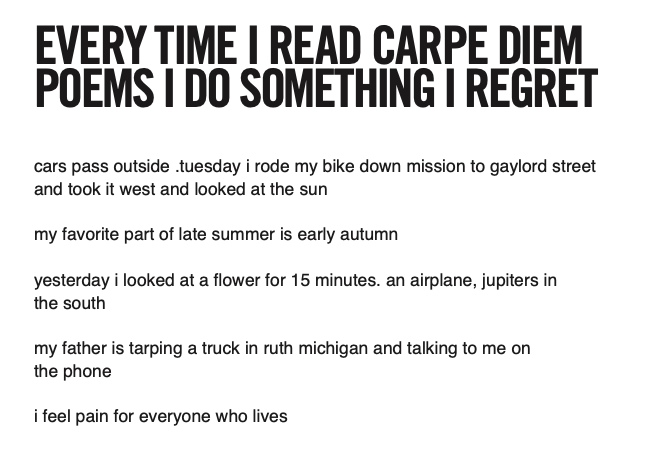
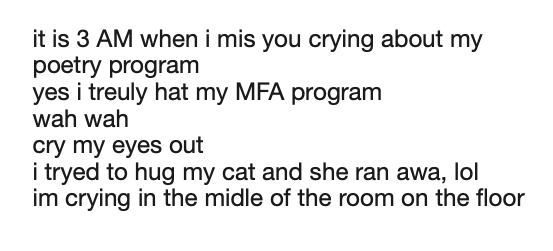
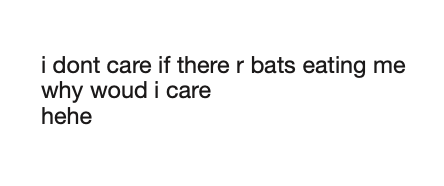
All of this was a revelation, and I quickly learned that there was an loosely affiliated movement of poets and fiction writers and a whole network of blogs, small presses, social media accounts, and online journals dedicated this new Internet-based writing. Some called it alternative literature, or “alt lit” for short, and, while many of them were quite familiar with poetic history, many others appeared to be reinventing poetics from the ground up—throwing out all the rules and norms of craft in favor of speaking directly from the heart. Some of these writers didn’t even make poetry or traditional prose. It wasn’t unusual to see a selection of tweets or an image macro in a journal next to a more or less “normal” poem. Anything that tickled the mind, that gave voice to a new form of despair, that used the scraps of inconvenient emotion, junk language, and bankrupt imagery generated by capitalism to rip a hole in the whole edifice, letting in some cool, fresh air from the outside—that’s what these people were after, and I desperately wanted to be a part of it.
One of the most interesting writers I discovered when I started posting on Tumblr that spring was J. Jennifer Espinoza, whose motto was “if you don't think crying is poetry you can go fuck yourself.”
Crying, whether out of joy or sadness, was very much Espinoza’s brand. To me, she was a mysterious, waifish creature; I only knew she was around my age and a trans woman and that, in her selfies, she looked beautiful and sad in some fundamental way. She was prolific, dashing out frequent missives on Tumblr and publishing with increasing regularity across the alt lit sphere. She loved calling herself “trash” and identifying as extremely gay (her Twitter handle is still “sadqueer4life”, and to this day she captions the great majority of her selfies with just the word “gay”), which was sort of exotic to me, a person who could count the number of queer people they’d gotten to know on one hand.
She seemed to revel in strong emotions as a sign of life. Pain had even created her:
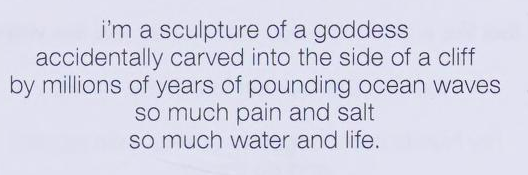
“i want to feel everything,” she declared at the end of the poem excerpted above, which served as the introduction to her first book, i’m alive/ it hurts/ i love it, published by Roggenbuck’s imprint Boost House.
Espinoza’s emotionally effusive persona split me. Sometimes, I romanticized it—she reminded me of a secular version of my beloved St. Gemma Galgani, who lived in a world of angels and demons and felt the redemptive suffering of Christ in every bone of her body; at other times, lines like “everything i’ve done/ comes from a place of dying” sounded melodramatic (I felt the same way when they came from Roggenbuck, as well, though I think there probably was some misogyny going on here).
I didn’t want to feel everything, I told myself. I wanted to feel less than I did. Nor did I understand the victory of survival, about which Espinoza bragged in the same way a rapper brags about their skill and their money. I was walled-off and antagonistic and I knew it. I could not boast about my compassion, like Espinoza could:
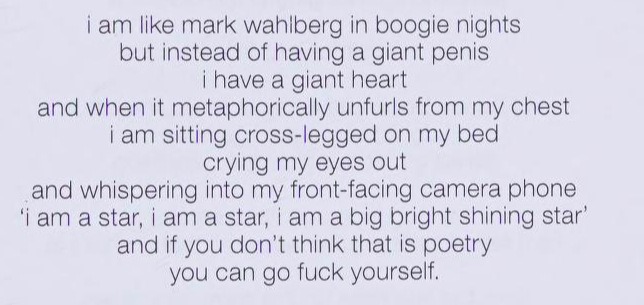
Today, far more in touch with my compassion, I find this stanza charming, and I realize I largely ignored the humor that’s always been a part of her work. But back in 2014, such lines made me feel defensive. Who could brag about being sensitive, as if it’s a strength? Who wanted to spend all their time crying? Get yourself together, I wanted to say. The world is going to destroy you. Your sadness doesn’t make you powerful or righteous or beautiful, it just makes you sad.
But if I said it out loud, I’d know I was only saying it to myself, and I’d hear how hollow and cowardly it sounded.
Not that there was a danger of that back then—I barely spoke out loud at all for most of the day. I worked remotely and I never saw much of anyone. Although I hid it from most people, I was angry, overreactive, and depressed. Alt lit was my escape. I spent most of my time on its social media, reading people’s work, submitting stuff, and writing mostly bad poems. I occasionally made videos of myself reading my poems, or doing absurd characters like Steve Roggenbuck—but without any of the inspirational material.
I don't know what the other people in my computer thought of me, or if they thought of me much at all. I did get published a couple of times. I even got a review from Beach Sloth, which I really really appreciated. I also said a lot of ignorant things and probably came off sometimes as a little sus. I didn't really know what I thought about anything. I wanted justice for everyone, but I feared social change. My opinions were a mess, and I offered them far too freely.
At any rate, the characters of alt lit became my parasocial “friend group.” Espinoza was part of that imagined social circle. She was one of the few poets I came across in the scene with a strong, consistently compelling voice and a real sense of pacing. It had power.
The other thing that kept me interested in her was that she spoke often of her experiences of transness and transphobia, internal and external. Prior to her, I’d never had a window into the life of a trans woman who wasn’t a celebrity or a character in a movie. When I wrote a roundup of my favorite alt lit figures on Tumblr at the end of 2014, I included Espinoza. I’m not super proud of the writeup, though, which was probably condescending, because it was less about her poetry than about how I found her relatable despite being a cis man.
Because, yes, famously, I was a cisgender man:
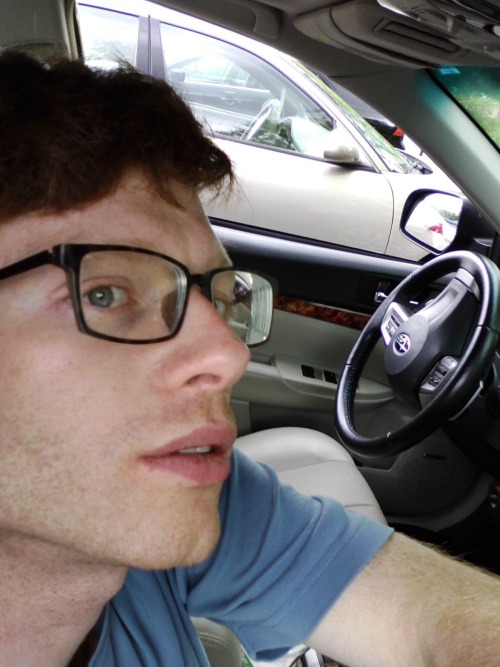
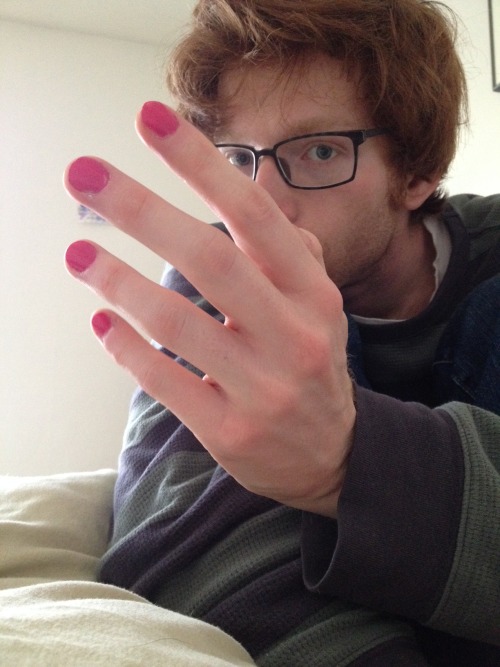
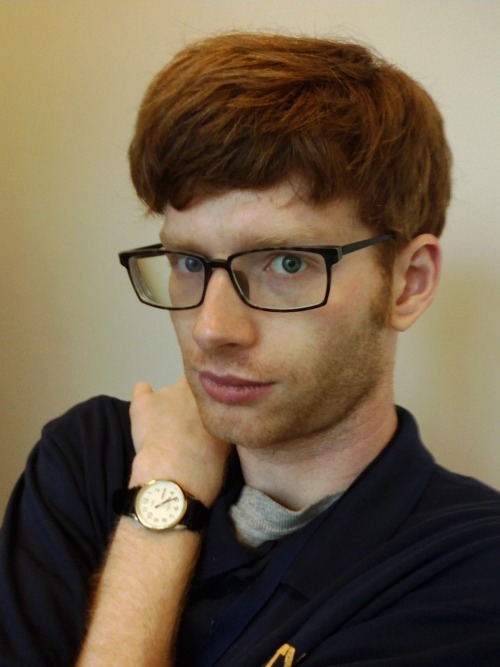
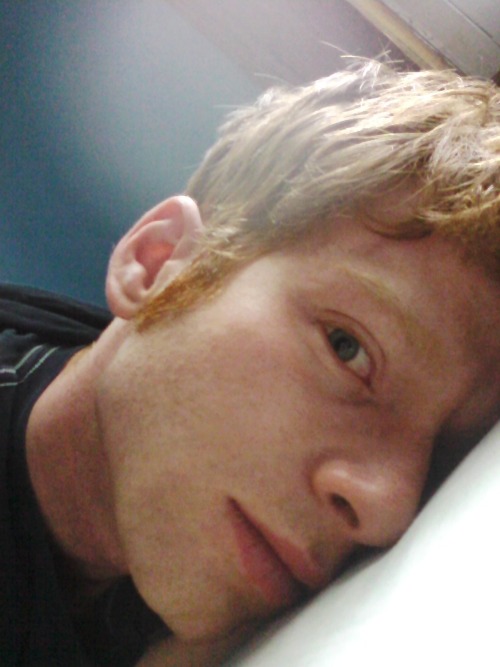
These selfies had originally only been for my girlfriend, but after I saw Steve Roggenbuck posting selfies shamelessly, I felt permitted, as a man (a completely cisgender man) to do the same—and as it turned out, it was something I desperately wanted to do. I liked being pretty—not handsome—pretty—and I wanted the world to see it.
Something was stirring in me, which I now recognize as "gender euphoria," but at the time it just felt like hypomania. By the end of May, I was declaring, drunk at a bar, to my sister’s gender studies major friend, “GENDER IS FAKE! IT DOESN’T EXIST! JUDITH BUTLER!” (even though I’d actually only watched the first part of a documentary on Butler and had no business referencing them, but the enthusiasm was a positive development).
As I continued to dig into Tumblr, I discovered the “sad girl” aesthetic that was already in full flower and overlapped heavily with alt lit, and it sent me. On one level, it was just sexy, but mostly I just directly identified as a sad girl. On the surface, this made no sense to me (the idea of me being trans was impossible, at that time, to countenance), but the emotions were too intoxicating to ignore. My girlfriend thought a lot of it was cringe and tried to ignore it.
On the surface I just told myself it was a funny quirk, or that I was just a “feminine man,” or that it was problematic but harmless fetishism—but that isn’t how it felt. It just felt like me—me in a way that didn’t make me hate myself. The only other thing that didn’t make me hate myself was making art.
Inevitably, I found myself listening to Lana Del Rey, the sad girls’ biggest icon, who literally had a song called “Sad Girl”. I was instantly hooked—what can I say? She just knew, and Ultraviolence became my album of the year. Other strange feelings emerged from viewings of Beautiful Darling, a maudlin documentary on Warhol superstar Candy Darling, and from re-watching The Little Mermaid, which I suddenly felt compelled to do one day after babbling to my therapist about how I identified with Ariel and it was like, super meaningful to me. He wasn’t sure what to do with that, and ultimately, neither was I.
All of this now feels so stereotypically trans, I almost feel like I made it up. As I’ve said, this was not a happy time in my life—it was actually one of the least happy and most isolated—but these feelings and enthusiasms, as confusing as they were, were like a glimmer of light in the darkness of it all.
Naturally, and despite my end of the year Tumblr roundup being mostly male, I became more invested in the women of alt lit than the men. A few other names I can recall off the top of my head, in addition to Espinoza: LK Shaw, Mira Gonzales, Shy Watson, Alexandra Naughton, Megan Boyle, Ana Carrete, Sarah Jean Alexander, Bianca Shipton, Moon Temple, and Stacey Teague, Melissa Broder (both her actual poetry and her joke account “so sad today”). To me, they were often the better writers—more honest, less pretentious, more relatable, and more interesting. The platforms that people clustered around were mostly run by men (Shabby Doll House and New Wave Vomit being notable exceptions), but, if you were me at least, you stayed for the women.
From Bianca Shipton’s amazing chapbook I Want to Destroy Something:
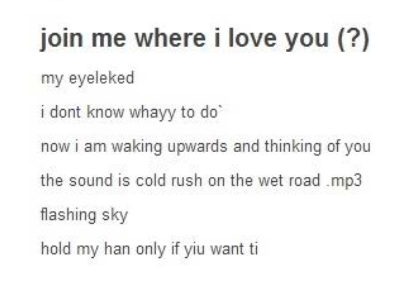
I think this poem is amazing, lol. Maybe you had to be there. Hope she’s doing well.
Toward the end of July, I even created a feminine persona named Carrie Lindsay to try to write like the alt lit girls. One of these persona poems was almost accepted by Melissa Broder for HTML Giant’s Sunday Service, but the website ended up going on a long hiatus before it could be posted, saving me the trouble of deciding whether or not to actually publish as Carrie. Here it is, fwiw:
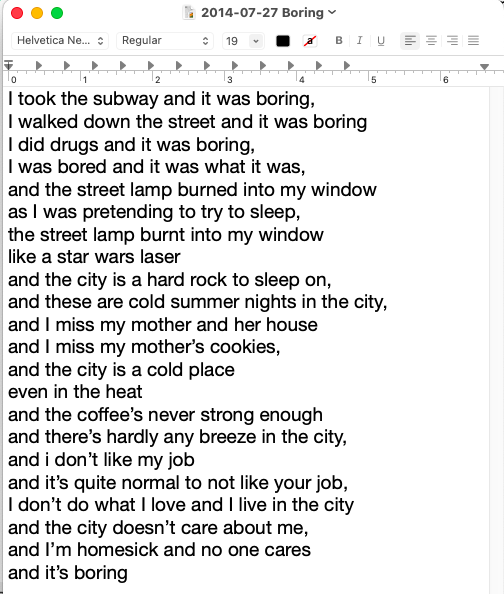
I only wrote four or five poems as Carrie. Looking back, it’s obvious that the voice is just mine—there’s no serious attempt to become someone else. But these poems had a spark that only a few of my other poems did. It was much easier to me to access my emotions as a fake woman than as a “real” man. As Carrie, I even began writing what I now recognize as gender dysphoria poetry. An excerpt:
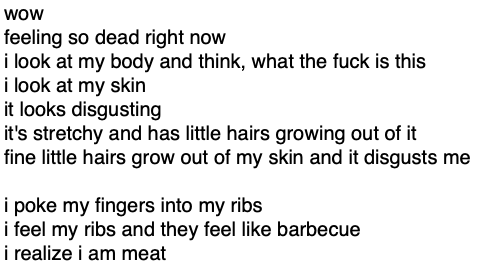
While she’s troubled and self-absorbed, Carrie is also playful and romantic. I like the person in these poems, crude as they are, a lot more than the person who wrote a lot of the poems under my legal name. That guy, well—he’s complicated—a little too complicated. He’s kind of reactionary, but he also feels kind of guilty about it. He doesn’t want it to make him into a close-minded asshole, and he doesn’t yet understand that this isn’t possible. He wants to be sweet, silly, and passionate, and sometimes he lets himself do it, especially with his girlfriend, but he also fears these things will make him weak, flimsy, vulnerable to attack, so he usually has to undercut them at the last minute with a bum note. To feel like he’s something solid, he needs to neutralize or ignore the experiences of many other people—people who call into question his assumptions about himself, the social order, nature, just about everything. He has his moments, but he just isn’t it.
In the short term, though, he won, and all the confusing but liberating feelings I’ve been talking about got repressed again, however unsuccessfully. By the end of 2014, my relationship with my girlfriend had completely deteriorated, which was better for the both of us. I ran off to Portland, Oregon, where I reconnected with a male friend and fell into his world, vicariously absorbing his more confident, stable masculinity as a way of deferring the gender question, which I still hadn’t even gotten to the point of being able to ask. Together we started a band that absorbed most of our time. My poetic output slowed to a trickle, and I pretty much stopped submitting.
In the summer of 2018, I couldn’t stand doing the band anymore, so I quit, and I signed up for a poetry/bookmaking workshop, and started writing again. At some point in the next few months, I realized that, for the first time in my life, the majority of my friends were women. In 2021, I finally realized I was a trans woman, even if I wasn’t yet ready to fully admit it. In 2022, I started an MFA program in poetry. In 2023, I started HRT.
As you might have put together by now, movements toward poetry and toward transness have always been connected in my life. I’m not sure why. I’m still trying to figure it all out. I’m patient, but it’s very strange, even while it makes all the sense in the world, to look back at your own history through a very different lens, and on top of this, to be an autobiographical poet who’s always relied on her history, whether recent or distinct, for material. I am so much happier now than I could ever have imagined, but I’m also aware of forms of suffering I didn’t even realize I’d been experiencing. I want to, but still don’t really know how to write about my mental health struggles, which did and didn’t have to do with gender dysphoria, or about being trans, and what it means to me. I don’t know what it means to write as a woman, or what I have to say about womanhood, which feels in many ways like a party I just got to. I don’t know what I want to share and what I don’t, and even though I was praised in workshop for my candor, I still feel like I share too little.
Whatever else she was up to from 2015 though the present day, Jennifer Espinoza continued to feel her feelings and be herself as an artist. She also seems to have hustled hard. I wouldn’t say I kept up with her work closely, but at some point I noticed that she got a second book, There Should Be Flowers, published in 2016, and that she’d been making the jump from underground lit to mainstream lit. In the last few years, she’s been published in several prominent places, including The Rumpus, The Paris Review, Granta, The Nation, and Poetry.
This is kind of amazing to me—someone who used to be on poetry Tumblr when I was, who was published in Voicemail Poems and Electric Cereal the same year I was, is lowkey famous now?! But it’s not surprising at all, because she was always good, did the work, and only got better.
The part where I finally talk about the goddamn book
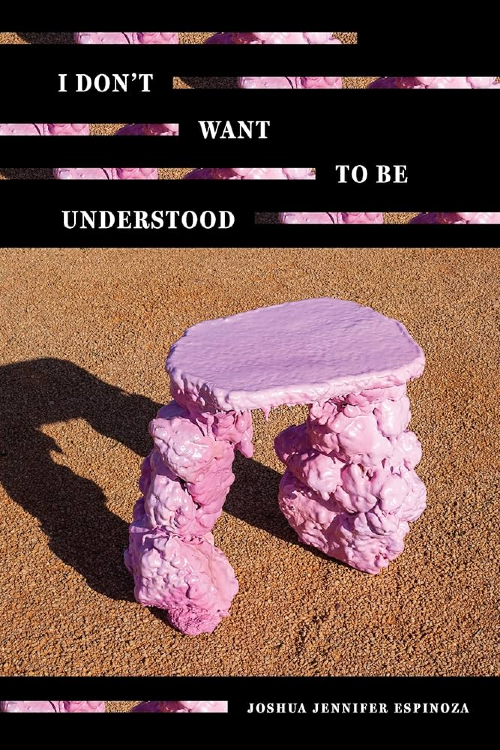
I Don’t Want to Be Understood, published in August 2024 by Alice James Books, stays remarkably true to the ethos of Jennifer Espinoza’s early work, while also exhibiting the refinement and introspection that come with practice and age (and going through an MFA program). She’s gone from charismatic Tumblr heart-on-sleeve wearer to confessional poet in the league of contemporaries like Ocean Vuong or Morgan Parker, and it’s inspiring to see.
Espinoza has always spoken in a colloquial, prosey way—the poetry here is more in the dazzlingly surreal way she treats embodiment and memory, and in the force of her rhetoric, strung taut between hyperawareness of both the beauty of breathing and seeing and tasting (“I want to enjoy the grass/ beneath my feet and sing/ songs to it and run my/ fingers through the soil and/ pray to the beautiful sky”) and the ugliness that human beings are uniquely capable of showing each other (I want to forget I am this/ woman in this world/ whose eyes are trained/ to look for any chance/ of violence”). Plain speech is usually the right way to deliver these lines, whose emotional power might be obscured by unconventional syntax. What’s requested of the reader is to listen and imagine, to remember with her, not to try to solve some kind of riddle.
Much of the collection, especially in the first half, sits on the border between imagination and “reality” (whatever that word really means)—memories, fantasies, unassimilated scenes of trauma. There’s an unsettling feeling in some poems, like “The Blueness in the Room”, “The Front Door”, and “Snow”, describing the menacing presence of an unnamed person, apparently an abusive father, in the speaker’s space. Part of this unsettling feeling comes from a lack of clarity as to whether we’re in history or some sort of traumatized loop of memory—it’s both, ultimately, but also, perhaps it doesn’t matter to a poet for whom "memory is not a part of the mind, but a chemical substance like water" (Housewife from Planet X”).
(Incidentally, a similar sense of dread accompanies the suburban spaces in I Saw the TV Glow, another great work of transfeminine art that came out this year. The shot of Fred Durst motionlessly watching television gave me the same feeling as the stirring of the unwanted presences in these poems. It’s not what we see Durst’s character do—almost nothing—it’s what he seems capable of.)
Suffering and trauma remain constitutive forces in Espinoza’s universe. We are built from them, and must find the strength to transmute them, hard as it is to come by: “Any time I’m doing something I’m doing something/ I’m afraid of,” she says in “Personal Statement”. Not everyone feels this way, of course—it’s the curse of the caring person: “I’m always like/ I don’t give a fuck when in reality I am literally/ going to die from how much of a fuck I give.” As for those whose privilege affords them the luxury of only partially giving a fuck, she calls them out in the poem’s final couplet with devastating sarcasm: “Don’t you want to rescue me/ from all the things that make you feel safe?” The sharpness of these statements as statements really knocks me out—it’s the sort of condensed, quotable language that Twitter teaches you how to construct, though few of us get really good at it.
While suffering is often human-caused and unnecessary, it also suffuses material life, even the structure of consciousness. Even time is described, at least in one place, as "a body full of damage/ that is constantly trying to forget” (“Gangrenous Love”); Espinoza also claims that she had to “fuck with the fabric of time in order to exist” (“The Present”). One could read the whole book, in its fractured autobiographical form, as an extrapolation of these two statements about time.
In one of a few poems simply titled “Poem”, she declares that “bliss is where I was never touched.” We might assume that the touch referenced here is an abusive touch, or perhaps also apparently loving touch from “careless hands” (also from “Gangrenous Love”) we eventually realized we couldn’t trust. But something makes me want to also read it on a more existential level—that to be touched at all, in any way, by anyone, is in some way to be irreparably damaged—at least for those with the sensitivity to be aware of it, who recognize the “infinite/ power/ in your/ so-called/ weakness.”
As grim as things get, as hard as it is to do anything sometimes, redemption of this always already fallen world is possible: “Our love and our grace and our tenderness/ [are] enough to change the shape of the universe” (“I Don’t Want to Be Understood”). But it is difficult work: “i made myself fight exceptionally hard to love me” (“Addendum”); “I fought to view the green of my garden” (“The Present”). It requires “an/ act of war/ against this/ earth” (the cleverly lineated “Your Weakness").
Espinoza uses transformations and identifications both as metaphors and as illustrations of a dissociative imagination for which the self is found not in the body, but in the fractured mirror of the material world. In “To My Parents”, she identifies as a series of actions, places, and objects from her youth—a maggot in a dog’s leg, the smell of mildew, the hole punched in a wall, a “predawn prayer ritual,” “the wind that took down the fences every fall.” She is everything in the poem except herself, the thing she wasn’t allowed to be.
Elsewhere, we find her as “vinegar inside clouded glass” (“Time-Lapse Video of a Trans Woman Collapsing Inward Like a Giant Star”), having been “born as a roll of paper/ towels,” and “in the body of a hummingbird” (“Poem”). In “Biography of a Snowstorm”, the addressee’s body is a “sleeping bag packed with snow.” In “Birthday Suits”, a terribly relatable account of “male socialization”, she unleashes a wild series of images to describe who she really is “beneath the cover of the flesh”:
five million faggy mountains
slicing through fields full
of dreamed-up tongues and
unnamable bluish grasses
each blade the length
of a universe
stretching inward toward
a singular point
of
life-sustaining unlogic—
To recognize the self as fragmented allows us, as Espinoza explains in “Today I Was Alone”, to see that the world, too, “is a world of pieces” which only appears to be held together by “the daily violence of cohesion,” the violence that humans perpetrate individually and collectively and pass off as normal—and to awaken to this truth is to become aware that much of what we have been told is normal is unconscionable (“Normal”). The truth is that things do not all add up. “God” does not have a “plan” (sorry, Drake). God is at best a fragile projection, “the sound of a promise breaking” (“Time-Lapse Video of a Trans Woman Collapsing Inward Like a Giant Star”).
Despite the insight they provide, these transpositions of self can also be problematic, and in the second half of the book, they’re sometimes deconstructed. In “Particulate Matter”, Espinoza tell us: “The moon was screaming.” A beat follows, via an extra space and an indent, and then, as if the voice of her therapist has spoken: “No. I was screaming.” In the shocking “Coercion Road”, she lucidly recounts seeing the corpse of a woman who’d thrown herself in front of a truck. She then finds herself unable to keep from identifying as the corpse: “I can’t stop seeing for her.” The horror of the scenario itself is doubled by the horror of an unconscious that thrusts the identification on her. Here, the split self is neither poetic nor adaptive—sometimes, at least, these splits result from the compulsions of a troubled individual who struggles, as she says in “A Confession”, to see herself, or even to know what it would mean to see herself.
On the other hand, she is exquisitely aware of how others see her. Several poems (“Makeup Ritual”, “Newsfeed”, the pair of “Airport Ritual” poems and the related “Departure”, “My Name—”, “The Heat Death of the Universe”, “Birthday Suit”, “A Confession”, “You’re Going to Die Today”) directly address the situation of trans women in a transmisogynistic society. These are authentic, well-written experiences, some of which hit me very hard.
In particular, the triptych formed by both “Airport Ritual” poems and “Departure”, in which Espinoza presents an outrageous, Akira-esque cinematic fantasy of her anger consuming everything (valid), then shows herself attempting to quell her emotions, then shows us the grim banality of what really happens, not only during the routine sexual assault provided by the TSA, but also at her destination, where she’s warmly but disconcertingly received by previously transphobic family members, is beautiful and powerful and painfully true.
What saddens me—and this isn’t her problem at all, but a challenge to the cis reader—is that most of what we get in these poems, realistic as they are, is a trans woman feeling how the cis world expects trans women to feel: bad. Bad when we see strange men on the street and no one else is around, bad when we get felt up at the airport because TSA still doesn’t know how to process the existence of our bodies, bad when we’re fetishized, even by other trans people, bad when we see all the hate for us floating around the Internet, bad when we feel valuable to the world only when we make ourselves as conventionally pretty and unobtrusive as possible.
Taken from the context of the book (or, almost worse, merely focused unduly upon at the expense of the book’s whole arc), these poems could easily satisfy the trope of the trans woman as a tragic figure whose accomplishment of womanhood is always out of reach—while her dream of womanhood testifies, in a tearjerking sort of way, to something beautiful and transcendent about the human spirit, about the power of fantasy, of the imagination. And in this way, she is reduced from a person to a mere example of the human spirit, a scapegoat for a guilt we haven’t begun to be able to articulate.
Espinoza is hardly unaware of the potential for some of her work to be read like this,. It is the sensationalist specter of the “Dying Girl” referenced in “Newsfeed”, which opens the more materially grounded second section of the book. In a post on Twitter this past June, she wrote:
When I looked back at my path as a writer, I saw what had started off as a difficult and nuanced struggle to articulate the messiness of self become flattened into writing about identity for the masses. It happened before I’d even realized it - all these requests and solicitations for “queer” and “trans” poetry, as if that was all it was. There was hardly any effort made to disguise the fact that my work was being used as window dressing, a “in this household we believe…” lawn sign in the front yard of the neoliberal literary establishment.
Again, the danger here lies in the attitude of the audience. Reading through this entire book, with its highly creative and complex explorations of traumatic personal history and the struggle to recover—and of the scandalous beauty of it all—you’d have to be beyond salvation to see this as some kind of “Dying Girl” book. This is a book about a woman who lived—the woman who rises out of the ash and eats men like air. If it is frequently dark, that’s because it is terrifying to survive. It is overwhelming. It makes you want to cry in joy and horror. And if you don’t think crying is poetry, well…
Go fuck yourself.
Suffice to say I no longer see Jennifer Espinoza’s work as overwrought; nor do I romanticize her as a suffering saint. Sure, my own aesthetic is more sardonic and understated, but that’s just a sensibility thing, and I’m seriously grateful for her generosity in sharing these things with me, the reader. After all, I could be anyone—and when you’re being this personal, that’s kind of weird to think about.
What’s more daunting, though, I think, is going back to these kinds of experiences in writing. I’m only a 10th as personal as her in my own writing and I have a hard time with this, so to me, she’s like some kind of badass warrior. Reading this book, I repeatedly felt inspired, filled with a desire to respond in my own way, and also to expand my own fairly narrow emotional range.
Toward the end of the book, we get a hautingly beautiful sapphic love poem, “This Is What Makes Us Worlds”. I assume it is sapphic, anyway, because of the final stanza:
Our love eats
the deadly sounds men
make when they see
how much magic
we have away
from them.
There are things men cannot understand, that they know nothing about, and it’s special to be a woman who loves another woman, and to be able to share those things, to have them as a secret, forever inaccessible. To me, this is a beautiful transfeminine poem, even though neither of the women in question are identified as trans. Prior to this stanza, Espinoza, using astrological logic, tells us her love has stripped the planets precisely “of their power/ to name things.” The poem is transfeminine in this spirit—because it was written by a trans woman about her own experience as a human being, not as a political subject to whom this name “trans woman” is affixed, with everything that comes along with it (a lot of it, at present, bad). The poem has nothing to tell cis people about being trans. It is not a transparent attempt to smile through tears about “queer joy”. It’s just beautiful, and true.
That’s what good art is. That’s what it has the power to give us.
That’s it.
The post is over.