The Million Moving Shapes and Cul-De-Sacs of Shadow
On the other side of New England gothic and Pia-Paulina Guilmoth's photography collection "flowers drink the river".

In 2018-2019 I participated in a writer’s workshop in Portland, Oregon that included instruction on bookmaking and print techniques as well as writing. For my final project, I wrote a long poem about some prepubescent memories from the South Shore of Massachusetts. With the more mature poetic eye and ear I have today, I mostly find the book artless and dull, but I was very happy with the poem at the time, and I think that’s because it was therapeutically important. Raised in a neurotic, ambitious middle class family, I internalized the notion that the Real World and the Real Me could only be seen through my parents’ eyes and the eyes of authority generally—never my own—but in writing the poem, I reclaimed my memories through my own eyes, and they are mostly memories of the wonder of sensory experience. The final lines, in which I reflect on a weariness I discerned in adults but couldn’t understand, sum this up best:
I copied their sarcasm I aped their exhaustion
but I wasn’t tired I loved the sun and the air
being warm between bed sheets
the waves tumbling into my face
crackling black seaweed on the shore
the hundreds of horseshoe crabs at low tide I loved
the thousands of crickets I loved
the air through an open window in the darkness of summer
Nighttime in summer is quieter in California, where I live now, than in New England. The crickets and other creatures singing in the dark in the East felt comforting, like a blanket, as did the humidity in the air. The air coming in from the darkness held possibilities, feelings, thoughts, and experiences that were excluded or forbidden—perhaps scary, but perhaps beautiful too. Really, it was beyond either category. It was Wild. In the Western symbolic matrix, that sort of beauty is usually associated, for better or worse, with the feminine: the darkness, the Moon, the Dionysian, whatever does not belong to the masculine, to the Sun, to the Apollonian. That most fateful part of a (cis) woman’s body, the womb, is a dark place, warm but dark. It is where we all come from; it holds and cultivates our possibility.
Everything has a way of dissolving in the dark. Whether something is hidden there from shame, or hidden there to protect it from those that might harm it (perhaps even one’s self), or not hidden at all, but just a creature of the dark, they all become equivalent. The sound of night is multiple, but also one. The darkness allows imagination to unfurl itself fully, unhampered by the limitations of the visible. In this way, it is democratic: hierarchy hates others’ privacy, secrecy, their ability to move about without its knowledge. We fear the dark because it may contain danger, but there is, I think, an additional, patriarchal fear on top of this more primal one—we hate the dark because it represents the limits of our control. It represents the profound mystery of matter-in-itself, independent of our ability to perceive and measure and predict its behavior.
Looking through the Maine photographer Pia-Paulina Guilmoth’s book flowers drink the river, I felt carried away again by a sensory memory of the crickets and the warm air, the thickness of summer nights in New England. For me, the gorgeous shock of these black-and-white pictures takes up the question of New England gothic, an aesthetic exploring (among other things) the razor’s edge of liberation and angst in what was supposed to be, for this land’s settlers, a new world, but which was already a very old one—the vertiginous sense of vast woodlands stretching for untold miles. Some of the settler’s dread, certainly, is simply a racist projection on nature, the notion of this land as “untamed,” “savage,” etc., and all the more threatening for it, even though it had been inhabited for millennia and was well known to its inhabitants, who had already studied and shaped it deeply, and continue to. From Charles Brockden Brown to Edgar Allan Poe to H.P. Lovecraft, the American settler’s mind has always had a morbid, paranoiac streak inspired in part by the dread of an ungovernable frontier that might swallow them up.
But the land and its inhabitants also changed the settlers, persuading some of them, in some ways at least, that not everything was theirs to take1, and this too is part of New England gothic—the mystical encounter with a self-possessed ecosystem that, despite the best efforts of dutiful Puritans to see it as made for them, is too strange and free, too gloriously amoral to have been created by anything. You can feel it in the quietly subversive midnight poetry of Emily Dickinson, in the Transcendentalists’ post-religious emphasis on immediate experience, in the fearful admiration that Herman Melville (a New Yorker, but close enough) shows for nature. Their thought and work proves that on the other side of the angst and mania to control the land, there might be a joyful embrace of the darkness, a surrender of the desire to tame, the wild thrill of a world without beginning or end. This is the call not of Dionysus, but of Pan, the older, weirder god of the woods for whom panic is named.
Taking on one or the other attitude toward everything that seems Outside will guide how you view these pictures. In one photo, several rows of masks made from large leaves hang on a clotheslines, a woman behind them, poking her face through one of them. Some are ghostly and disconcerting, others are sort of cute. Are these hideous folk horror props? Sublime devotions to a powerful, multiplicitous spirit? Perhaps just an eerily charming craft project? The difficulty of the dark is in the ambiguity.
I like when photographers write a little bit about the pictures. This is what Guilmoth has to say, and I think it connects this theme of the embrace of the strange and supposedly wild with the book’s transfeminine themes:
each night for a week in august i would sit in the tall, tick-infested grass behind the orchard covered in Scent Killer Gold, wearing a ghillie suit, holding a tray full of crushed apples in one hand, and a 30 foot makeshift shutter release cable attached to my 4×5 camera in the other hand. the same family of deer would get more comfortable with my presence each night. eventually they were eating the ripe fruit from my hands. the following tuesday i would have my first hrt consultation. i was keeping it a secret, knowing there was no way i could safely transition in this place, but also no way i could hide my changing body over the following months and years.
Pretty much every piece of transfeminine art I’ve written about so far on this blog is acutely aware of trans women’s precarious place in society—some, like I Don’t Want to Be Understood, only touch on it, others, like Castration Movie, are explicitly about it. But in subjecting Guilmoth to a trans reading, we find only the most primal, sensual dimensions of that experience, the gut feeling of repressed femininity pressing on consciousness, the rattled joy of its rediscovery, which can feel both euphoric and like the end of the world, and the clandestine nature of its cultivation and maintenance in transition. These photos shine a light on the things that are ordinarily only felt. They present themselves to us like the artifacts of dreams, resisting analysis not because they are too obscure but because they’re so immediate.
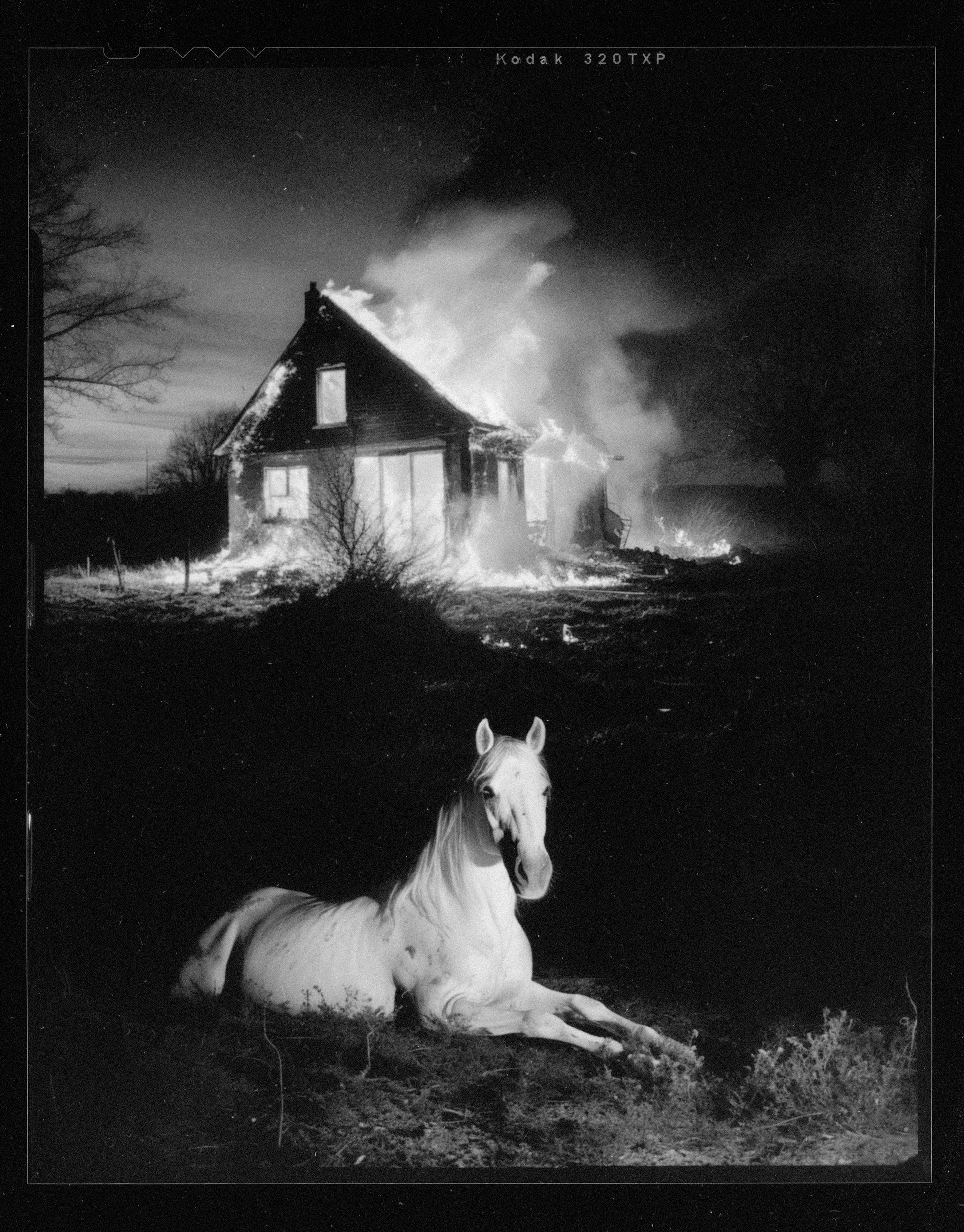
Many trans women will tell you that, as children, they had no available words or framework to think about or name the obscure but palpable longing they later identified as a desire to be female. They may have been able to state this desire, at least to themselves. It may have come up often, and yet they were not afforded a way to make it meaningful, which is how it came to belong to the night.
As I discussed in my essay on gothic femininity, this lack of language or concepts is not unique to trans women. In a society in which so much of girlhood and womanhood is relegated to the dark, we find our cis sisters there with us, and we begin to realize we are not so different from them after all.
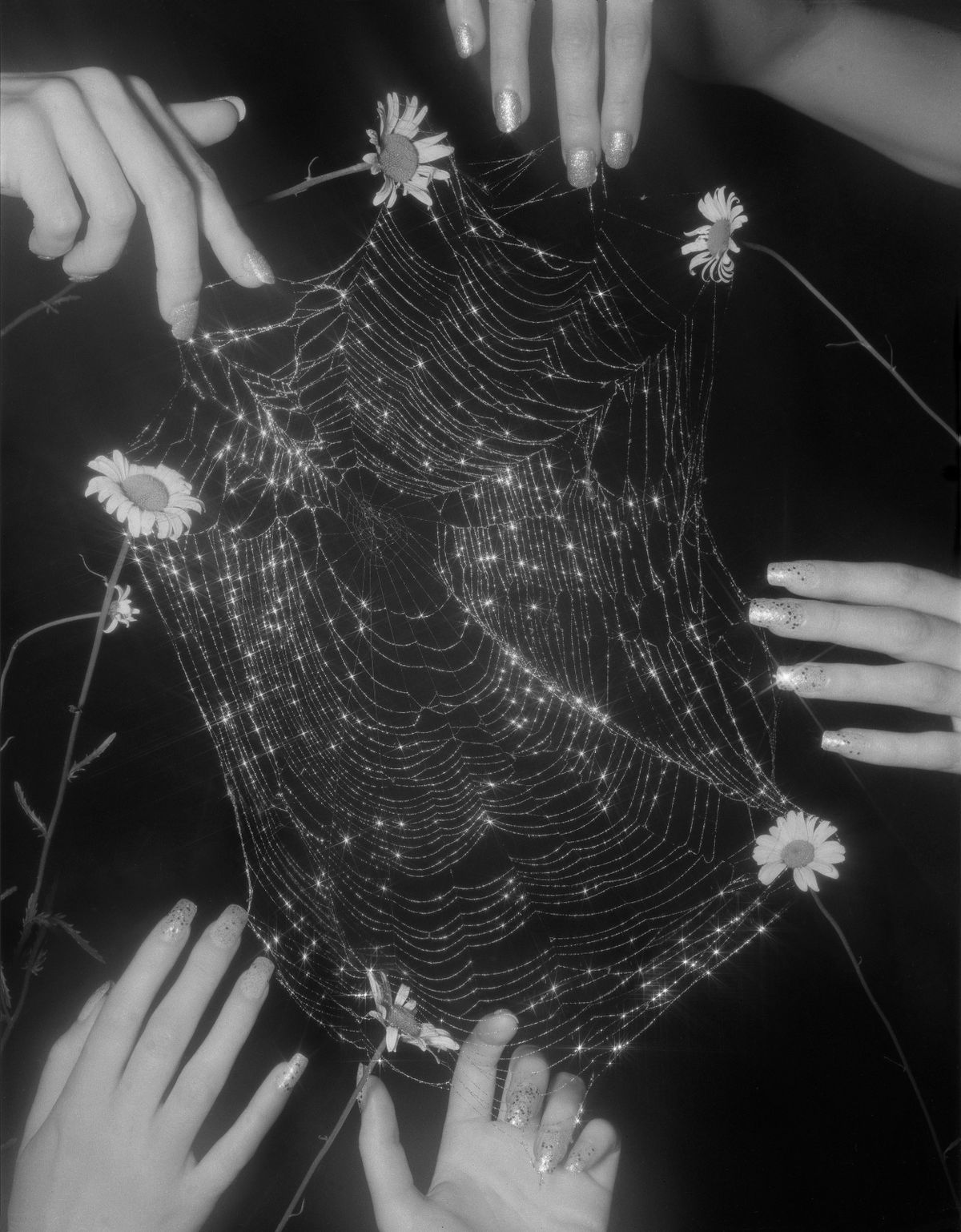
Women appear here in several photos, but they are usually difficult to clock. Their womanhood is what matters, and Guilmoth’s female symbolism is quite traditional in the sense of mostly being vaginal—flowers, caves, spider webs, pools. An image of icicles whose fragility undermines their ability to firmly represent the symbolic phallus is perhaps the closest thing to an acknowledgement of the possibility of a female penis in both its exceptional and, often for its bearer, alienating qualities. We are included, then, as trans women, but not dwelled upon. Rather, we take our place in the larger story of women, most of whom have not been our kind of woman. Their vaginal symbols are ours; our phallic symbols are theirs. In the darkness, again, everything is equal and anything is possible.
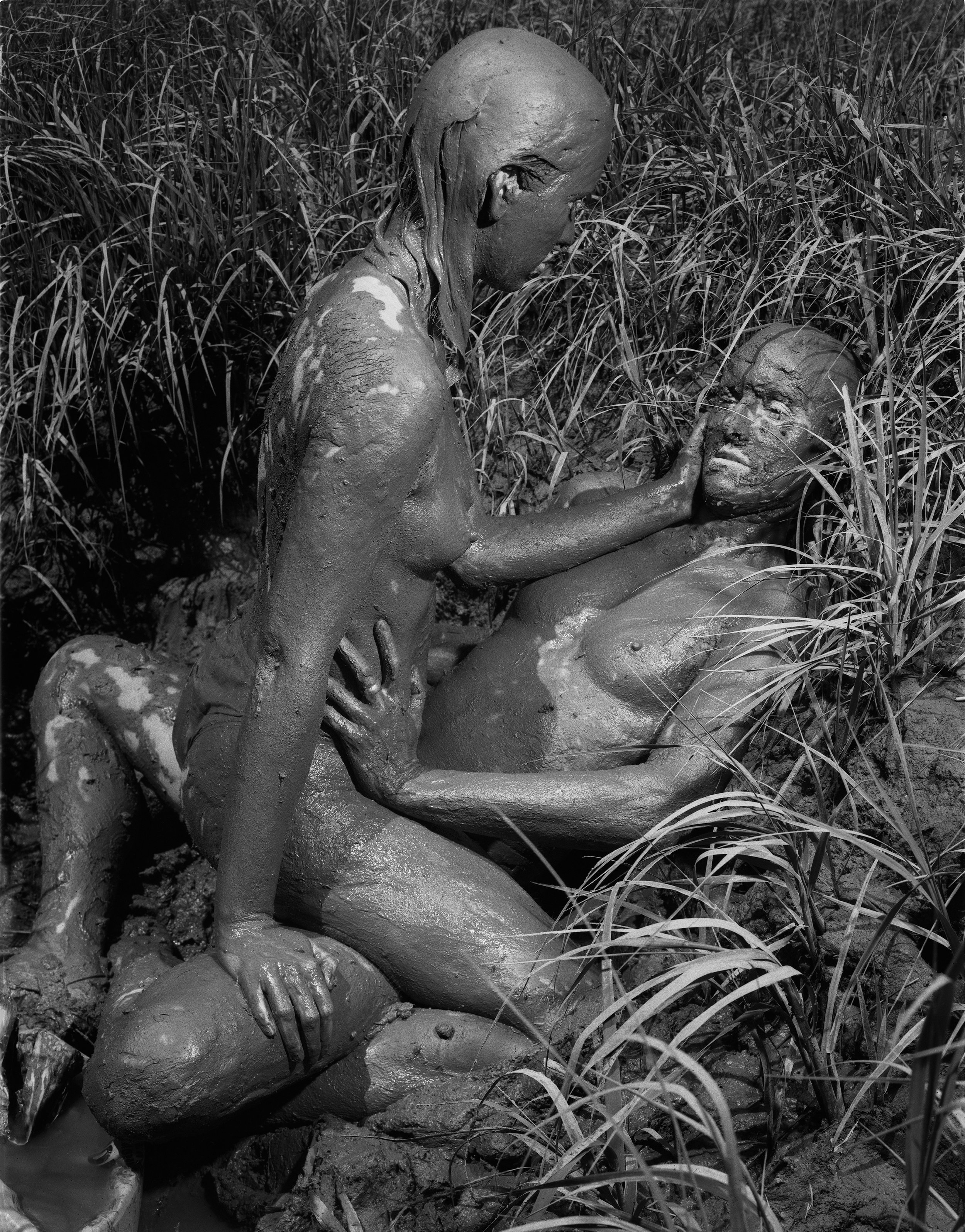
I’ve also spoken elsewhere of the importance of photography for trans people, how it allows us to present ourselves as we wish to be seen. Guilmoth’s project turns this impulse upside-down, emphasizing the ways in which we are unseen, even by ourselves. She provides the viewer with a brief window into that secret world, but it’s not a world meant to be lit, except by the moon and the stars. Transition is often presented in a conquering settler language as a subject taking control of themselves and their destiny, subduing their body to fit their fantasy. The notorious Michigan GP Will Powers speaks this way about treating the trans bodies under his care: “I only use this drug,” he says of a particular anti-androgen, “to achieve what I call capture. Capture is the point when I own your endocrine system. It does what I tell it.”
Fierce, hunty. A little too fierce, actually. What if transition were something else—a journey further into the darkness, into the weird mysteries of nature, a response to an impulse older than we can understand, whose justification is already contained with it?
In The Bell Jar, Sylvia Plath (another New Englander) recalls, through her proxy Esther, a dark daydream during her long depression in college:
I thought the most beautiful thing in the world must be shadow, the million moving shapes and cul-de-sacs of shadow. There was shadow in bureau drawers and closets and suitcases, and shadow under houses and trees and stones, and shadow at the back of people’s eyes and smiles, and shadow, miles and miles and miles of it, on the night side of the earth.
I don’t think this quote should be limited to a strictly depressive interpretation. Plath was enamored with the shadow realm, and it was perhaps during her first breakdown that she became consciously aware of its beauty. It is a moment of seduction—no wonder the Puritans were so afraid. Part of New England gothic is this closeness of beauty and terror—what the Lacanian psychoanalytic tradition calls jouissance, an enjoyment that frightens us because it is beyond our capacity to assimilate to our established language and categories. It may provoke horror, or shame, or scandal. We must either run from such an experience, seek to subdue it, or creatively expand our understanding to accommodate it.
So here you have it: a light on the darkness, just for a night. Then it’s up to you to remember that part of the darkness that knows you, and loves you, and to trust it. When I think of it, I can hear the crickets again…
In their book The Dawn of Everything, David Graeber and David Wengrow remind the reader that European leftism was directly inspired by the egalitarian ethos of North American indigenous socio-political systems. ↩